Interspectional Rewind: Celebrity, Social Media and the Responsibility of Fandom Leadership

Building Communities in Fandom, part 2 Interspectional

So you’ve answered the call to be an active fan. You’ve fought the trolls and won. You’ve stood by your friends when they fought their own battles and together you are all standing strong. But now, they come to you, saying that they need last thing from you. As these are the friends that have become your family, of course you reply, “Anything.” And then they say one of the scariest things you have ever heard.

“We need you to lead us.” I, myself, have never answered that call, although I do trying to be responsible with how I use my voice and share my opinion. In the last episode of my first season, I wanted to interview people who had answered that call and built fandom spaces that were open to difficult conversations around mental health and social justice as well as explicitly sought to protect its members of marginalized identities.

In part 2 of the episode, “Building Communities in Fandom” to Bianca Hernandez-Knight of The Jane Austen Universe and Virtual Jane ConJaycee Dubyuh of GAPOC: Gaymer Allied People of Color and Neisha Mulchan, MPH of Diversely Geek discuss the dark side of fandom and what exactly does it mean to be a leader in the fandom space. It’s a role that is both hard to define and incredibly important. A position can be extremely powerful and yet easily dismissed. Those of us who have been members of those communities know that its not an easy job. Between moderating people, creating your own content and possibly being contacted by the corporate media machine yourself, it’s a lot to take on.

One of the most interesting things about fandom leadership is that it’s a job that many have had, from ages as young as 12 or 13 and yet it is a responsibility no one expects and a job few can prepare you for. One minute you are nerding out with your best friends, the next minute you are building a website, creating community guidelines, handling interpersonal conflicts and someone asked you to be the moderator at a con. You are no longer just a fan, you’re a Big Name Fan (BNF). And being apart of the fandom is no longer just about seeing the movie, buying the merch and scouring the internet for sneak previews. Now people are LISTENING to you, your opinions have lasting consequences and there is a pressure to protect those who have sought safety in the community you built as well as the power to unleash your fans and followers at a target if necessary. And as any comic book fan knows:

It can be hard for people outside if the fandom community to understand the power that one can hold in a fandom. But it would be foolish to ignore the lasting impact that a person can have in the online space. In fact, it can be argued that one of the watershed moments of our modern era, Gamergate, is an example of the destructive dark side fandom and fandom leadership.

In this world of influencers, social media gurus and viral TikTok stars, it seems like a person can gain a platform and an audience nearly overnight. But unlike actors, directors and professional writers, the personalities on interactive platforms have a more intimate relationship with their audience. Traditional celebrities have never really had to ask themselves about their responsibility to the public or the image they create until very recently. As a child of the 90’s, I have vivid memories of celebrities often claiming that they “weren’t role models” in an attempt to distance themselves from the impact of their influence. Corporations like Disney, Paramount or Warner Bros. have largely stayed out of the communities that have evolved from the content that they have put out the public. But those aren’t the rules in the fandom space. As the public has grown more accustom to having a level of intimacy with the people that create their entertainment, the lines of separation have blurred in the traditional media space as well, especially with celebrities and creators becoming a presence on social media platforms themselves. So the questions becomes when a community is built around yourself or something you create, are you responsible for leading them?

On the TikTok and Twitter-verse, I’ve seen two responses to this. One response is that as people starting gaining followers, they put out a PSA or community guidelines along the lines of “Hey. This is what I talk about. This is what I expect from your engagement. This is how I expect you to engage with each other. Violate this and you will be blocked/dismissed from the conversation.” While this response is responsible in my opinion, time and experience have shown that this is not the way to get a million followers overnight. It seems like gaining an audience while trying to maintain a level of integrity is a quick way to a slow trickle of notoriety. To be fair, it can be done as shown by the creators such as TheBlerdGurl, Women At Warp and Angry Asian Man. But as the algorithms of social media sites tend thrive on controversy, the content creators that get a large platform fairly quickly tend to sound more like, “Do what you want. I don’t care. Wanna watch me start a fight?!!”, when they address their community.

Celebrities seems to be torn these days about what the proper response is. Some have thrown caution to the wind and let the fallout, be the fallout. It would be foolish to ignore that fact that there is a vocal section of the internet that will embrace every hateful thing that a person could put out there. And what someone loses in respect, they can gain in notoriety and to some, that’s a fair exchange. For others, being or standing up for an underrepresented or marginalize communities comes with its own challenges. In a career where your viability is often based on how “likable” you are; it can be difficult to make a decision to maintain your affable distance or make a statement that could turn the dark side of fandom against you.

Both the hesitation and baptism by fire of celebrities dealing with the dark side of fandom are exemplified by Flash‘s Grant Gustin and Candice Patton. Grant Gustin plays the superhero, Barry Allen aka Flash, and Candice Patton plays his main love interest-now wife in the show, Iris West-Allen. In 2014, when Candace Patton, an African-American actress, was cast to play Iris, a traditionally white character in the comics, the online backlash was loud, abusive and unabating. While much of it has cooled in the subsequent years, the negative and racist messages sent to both Grant and Candice were frequent enough that blocking trolls and defending themselves against people online has become a constant in their lives. For Candice, this experience put her in a leadership position by default because she was the first in what is now a long line of Black women to be cast in television and movie comic book adaptations. She has been the guide both in her industry and to the women of color who have watched her and been inspired by her strength and tenacity if the face of vitriol and prejudice.

Grant Gustin, on the other hand, took a long time to be vocal about his support of his castmate. He’s previously stated that he blocks these problematic folks, but they are not worth additional energy. He has since evolved to attack some of these issues head on, but it took time. This can also be seen as a question of leadership. Fans have pointed out that an earlier and vocal defense of Candice Patton could have lessened the racist remarks that she received. Was it his role as an actor to push the fandom that had been built around his character into a more positive, less hateful space? Many would say “yes”, some would say “no”, but the fact is Candice Patton had no choice in the matter. So it would make sense for the leading man to take on the leadership role even if he never asked for it.

Grant has stated that him being an introvert was part of his reason for not getting into the fray, but I also think that part of it is his image of being a fun, likable and non-threatening actor. Standing up for other people requires that you break the image that people project on to you and suddenly you are standing there as person with principles. And these principles might be the reason that some fans turn against you. One only needs to look at some of the comments in Grant Gustin’s Instagram post below to see some problematic people making themselves known.

And finally you have the leaders that created a community purposefully. Those who saw a need, saw people yearning to have a place to belong and took it upon themselves to make that place a reality. The kind of leadership doesn’t necessarily get notoriety, but a leader can get a level of power and influence that can be used for good or for ill. Sometimes those communities have a leader who is focused on service to the people themselves and others times a cult of personality evolve. There’s also added level of intensity that occurs when when BNFs and fandom leadership feel a responsibility to call out the prejudice, racism, sexism, transphobia, fatphobia etc. that shows up in both the media that created the fandom and within the fandom itself.

The road of responsibility and leadership is not an easy one. It can be full of peril and strife, of making mistakes and causing accidental harm. It can also be one of beauty, love and putting something out there in the world that can help another person and make them feel seen. Positive leadership is challenging, complex and I respect everyone who tries to do it. We all have our role to play in making our corner of the world just a little bit better, brighter and humane. And to those of you who answer that call in the fandom space that is both highly overexposed and still massively misunderstood: I salute you.

Interspectional Rewind: The Hero’s Journey of Fandom

Building Communities in Fandom, part 2 Interspectional

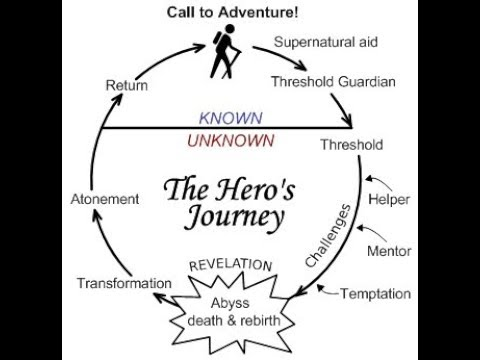
Much like the heroes that many of us follow, the journey from Fandom Neophyte to Fandom Veteran is incredible, exciting and full of danger. It is truly a hero’s journey in and of itself. For those who don’t know, “The Hero’s Journey” is a template or pattern of storytelling that shows up in everything from the ancient stories of Odysseus to The Hobbit to Pixar’s Turning Red. The Hero’s Journey as described in Joseph Campbell’s The Hero Of A Thousand Faces looks like this: 

So how does this apply to fandom? First, I want to mention that almost everyone has a combination of both passive and active fandoms. You can be passionate about football and only casually interested in Star Wars. Or the Marvel Cinematic Universe lives in your blood, but you’ll sit through Lord Of The Rings if someone forces you. But the journey from passive to active fan and then from fan neophyte to fan veteran is an interesting one. So we start this journey where all of these stories start… With the Call to Action


Typically, I think, something in the book we’re reading, show we’re watching, game we’re playing etc.. calls to us. Something that we are experiencing speaks to where we are in that moment of our lives or we see a story that makes us feel powerful or magical because we connect to the characters. Something about what we are seeing or doing makes us FEEL seen and valued. Suddenly, we are no longer just entertained, we’re excited, we’re involved, and we want more. Thus begins the journey of seeking out more and seeking out others like you.   

Crossing the Threshold

Do you remember when you joined your first fan community? Logged into a group chat where people were talking about YOUR THING? Maybe you joined a meetup or facebook group? Or did you go to an event. No matter how you did it, at some point, we all cross the threshold into the world of the FANS. It’s loud and numerous and overwhelming. It’s a wonder to realize that there are so many other people like you. And in the beginning, it can feel like coming home. 

Meet the Mentor 

If you’re lucky, you can often find a veteran fan to take you in and show you the ropes. Much like the breakdown of groups in a high school lunchroom, you’ve got to learn who’s sitting where, what the feuds are and how to navigate a new space. It’s around this time where you realize that this might not be the utopia you were expecting, but it’s still exciting.

Join The Community

This is the training montage. You’re learning quickly. Laughing loudly and feeling comfort and trust among the people who may just become your new found family. 

The First Challenge

You’ve gone through the training montage of your fandom experience. Your mentor has shown you the things that they love. You’ve been introduced to your first community. You’ve observed the trials and the trolls that your new friends have fought and conquered in this new fandom realm. And suddenly, it’s your turn. Either you have been called out or you found a battle that you cannot ignore. Either way, you feel ready to ride into the fray! 

The Work Continues 

Whether or not you succeed in your first battle, the result is the same. You have now become KNOWN. Some other factions might start to see you as a challenge to conquer or target practice. Either way, their goal is to push you into silence. 

The Abyss and the Dark Night of the Mind

The days you wonder if the fandom is worth it. You are challenged again and again. Battle after battle. You’ve seen friendships break. Trolls attack and maybe even a traitor or two in the community. What once brought you hope is now painful. There is no way that it is worth it. 

The Revelation

Your mentor tries, but can’t quite convince you that it’ll all be okay. Your community wants to support you and you’re grateful, but maybe it is still time to hide. 

But then you get a message:

“Hey. You don’t know me, but I wanted to let you know that your fic really meant a lot to me.”

“Thank you so much for standing up to that person. The fandom can be a trash-fire, but it helps knowing that people like you are around.” 

“I’m OBSESSED with your fanart. Please tell me you have t-shirts or posters!” 

Suddenly you realize that it’s not just the movie, the book, the tv show, the sport that is affecting people, you are too. In your tiny sphere of influence, your work is special to someone, maybe many someones. And maybe the positivity that you get from the media, the sport or the activity and the positivity that you put in the world as a result is more important than the negativity that you receive in between. Maybe it is worth it to get up and keep on going. 

The Return

You’re ready to teach what you have learned. And keep on learning yourself. It might even be time to find your own mentee or take an even bigger leap, and move on to leadership yourself. And THAT is its own journey. 

Fans. Sometimes, we get to be our own heroes.

The next post in this series will be about Fandom Leadership. In the meantime, if you like this blog and/or the Interspectional Podcast, please support our Kickstarter to help us continue this work: https://www.kickstarter.com/projects/interspectional/interspectional-season-2

Interspectional Rewind: When Fandom Was A Joy

Building Communities in Fandom, part 1 Interspectional

Before I had the chance to properly watch the Disney/Pixar movie, Turning Red, I came across the following tweet:

With in a few hours, this tweet went viral with thousands of people sharing the summaries and links of the original novels, fanfiction, and fanart that helped to shape their preteen/teen years. People shared other fun, but unglamorous shenanigans that were apart of their teen experience like trying amateur witchcraft or forming wolf packs or creating new languages. As someone who was a fangirl in the late 90’s/early ’00s (with the fanfiction.net account to prove it), this tweet was confirmation that Turning Red was a film that I would relate to on a visceral level. I may not be Chinese or Canadian or turn into a big red panda when I get emotional, but I did have a diverse group of friends with whom I traded manga, attended Renaissance Faires and went anime conventions with during my teen years. Feeling shame for my interests and/or joys at time, was not apart of my vocabulary.

2002. Me at 16, fanfic writer and playwright. Theater camp attendee. Girl with big stick.

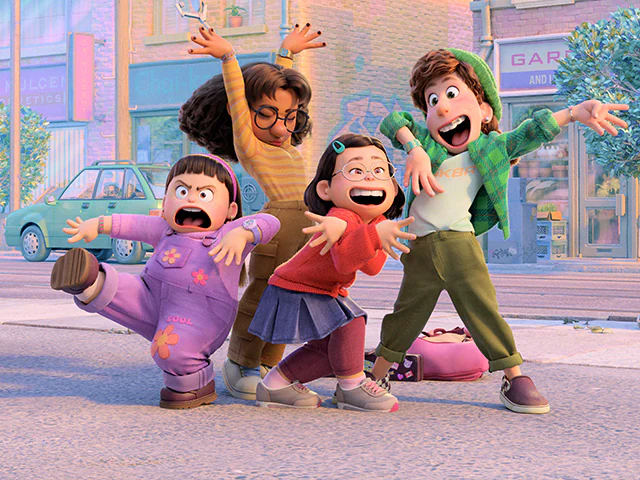
Being that the film was set in 2002, a time before social media took over the world and when TRL was EVERYTHING, I was definitely hit with waves of a nostalgia for the time period. But also watching the girls of Turning Red going through epic and creative lengths to see their favorite band live, I was also hit with sense that this movie captured the experience of fandom in its purest, most joyful form.

Abby (Hyein Park), Priya (Maitreyi Ramakrishnan), Mei Lee (Rosalie Chang), and Miriam (Ava Morse) in Turning Red. Note, if you’ve never danced in a parking lot with your best friends to your favorite song, you are TOTALLY missing out.

It’s hard to remember a time when fandom wasn’t so heavily commodified. When the MCU didn’t take over our lives, releasing new media at rate nearly impossible to keep up with and everything wasn’t its own cinematic universe. A time when access to your favorite celebrities or writers was restricted to magazines and possibly an autographed picture if you were lucky. This also coincides with the period of time where being called a “geek” or a “nerd” was still considered an insult instead of a badge of honor. That was the fandom era that raised me and the era the Turning Red takes place in. Even though the massive events were often well-attended at the time, as observed in the movie, it was the day-to-day, smaller in-person and online interactions that really kept the fandoms going.

In the Interspectional season 1 finale episode, “Building Communities in Fandom”, I speak to Bianca Hernandez-Knight of The Jane Austen Universe and Virtual Jane Con, Jaycee Dubyuh of GAPOC: Gaymer Allied People of Color and Neisha Mulchan, MPH of Diversely Geek. Each one of my guests are leaders in their own fandom communities, but before we got to that part of the conversation, I talked to them about their fandom experience. I asked them questions like: “What was it like to met your first friend in fandom?” “How did it feel to read something you really connected with?” They each gave answers that centered around the experience of feeling seen and not being alone. Connecting to a piece of media that describes an experience that you don’t have the words for or that tells you a story that you need hear can be a revelatory experience. Also the ability to connect with others in a small group based on a shared interest can give us the chance to build life-long friendships and be with people who see us without the weight of familial or societal expectation (as we see with Mei’s friendships in Turning Red).

It can give us the freedom to be joyfully ridiculous without being mocked or made to feel unworthy of care or respect. While fandom is most often based on a commodity, this friendship-focused, non-commercial aspect of fandom is something that I think can get missed in our modern of age of helicopter parent-like corporate involvement and the millions of opinions we have access to on social media. In a world where fandom has become identity and livelihood for many people, it can be easy to forget why and how we got involved in this culture in the first place, especially when trolls start coming out the woodwork or things just start getting too intense. Sometimes, it seems like we forget that fandom is supposed to be fun.

Now joyful fandom engagement doesn’t mean ignoring the things in a piece of media that you might find harmful or problematic. We can love something with all of our hearts and still admit that could be better. Or that possibly something that was just part of the lexicon of its day was just not right and is less so now. One cannot underestimate the influence of media as whole because media shapes people’s opinion about life, society, love, people whom they’ve never met and even how they think life should be. Books, movies and television shows are essentially cultural artifacts and as such, they do deserve to be examined, analyzed, placed in a cultural context and dissected as a reflection and/or critique of the society that birthed it. It’s important that look at the ideas that a piece of media reinforces and the new ideas that it promotes. I, for one, try to come at things through an anti-racist, gender-inclusive, lgbtqia+ inclusive, disability informed lens because these are the folks who have been excluded or marginalized in media presence and perspectives for decades. The critical eye can still be loving one, it just means that we see the rose and the thorns and realize that the picture is incomplete and inaccurate if you don’t acknowledge both.

So as I look nostalgically at Turning Red as it very closely reflects my 2002 world at me, I also have to acknowledge that this piece of media could only have created within the past 3-5 years. Only recently could studio executives believe that the story of a Chinese-Canadian girl could be successful which wouldn’t have been possible without the success Crazy, Rich Asians (2018), Shang-Chi (2021) and other projects with diverse, culturally specific casts that have premiered over the past few years. I have admit that with the movie’s presentation of a culturally diverse Toronto, a diverse friendship circle and even a diverse boy band, Pixar’s 2002 is a lot more inclusive and welcoming than what I grew up with. And that could have only been done with a joyful and critical look at the past.

So in this age where fandom is SERIOUS business, BNFs (Big Name Fans) can have a lot of power and there’s more direct access to creators than ever before, I want to remind you to have fun. I want to remind you that you don’t have post everything you sketch or write. Some things can be just for you. And the fandom joy that you get from talking to a friend about a movie that came out 15 years ago is just as valid a form of fandom as influencers that get to go on the red carpet. It’s all about the unabashed joy and the connection that you feel to the work that has been put out there. So go be “cringe” with pride, because we all deserve that kind of freedom. I want just to leave you with these final bits of advice about (positive) fandom.


1. Embrace your fandoms and healing hobbies

2. Find positive communities

3. Celebrate without fear.

4. And when things get intense, remember the family (found, birth, online and otherwise) that love you, just the way you are.

Best of luck out there. I’m rooting for you!

P. S. If you enjoyed this blog and my podcast, please consider supporting my Kickstarter campaign. It’s live from now until the end of April.

Interspectional Rewind: Who belongs in Historical Fantasy?

Star Trek As Period Drama Interspectional

While Star Trek takes place in the future, so many episodes either take place in the past or have a time-period-specific aspect to them. These "bottle episodes" have a tendency to pose complex questions around sociology, psychology and ethics. Focusing on episodes from Star Trek: TOS, TNG, Voyager and DS9, we'll look at these period dramas in space, the themes that can be examined from these episodes and how science fiction makes these stories unique. This is a recording from Women At Warp's IDIC Podcast Festival. For this panel, my returning guests were Bianca Hernandez  (@bookhoarding) for the season 1 finale: Building Communities in Fandom and Dr. Luz Rosines (@LuzXRayMD) from the S1:E3 – Latinx Representation in Space. 

Hey Everyone! Welcome Back to the second post of Interspectional Rewind! Continuing some of the themes from last week’s post, I want to invite you to talk a listen to the episode “Star Trek as Period Drama”; particularly listening to it through the lens of historical accuracy vs historical fantasy.

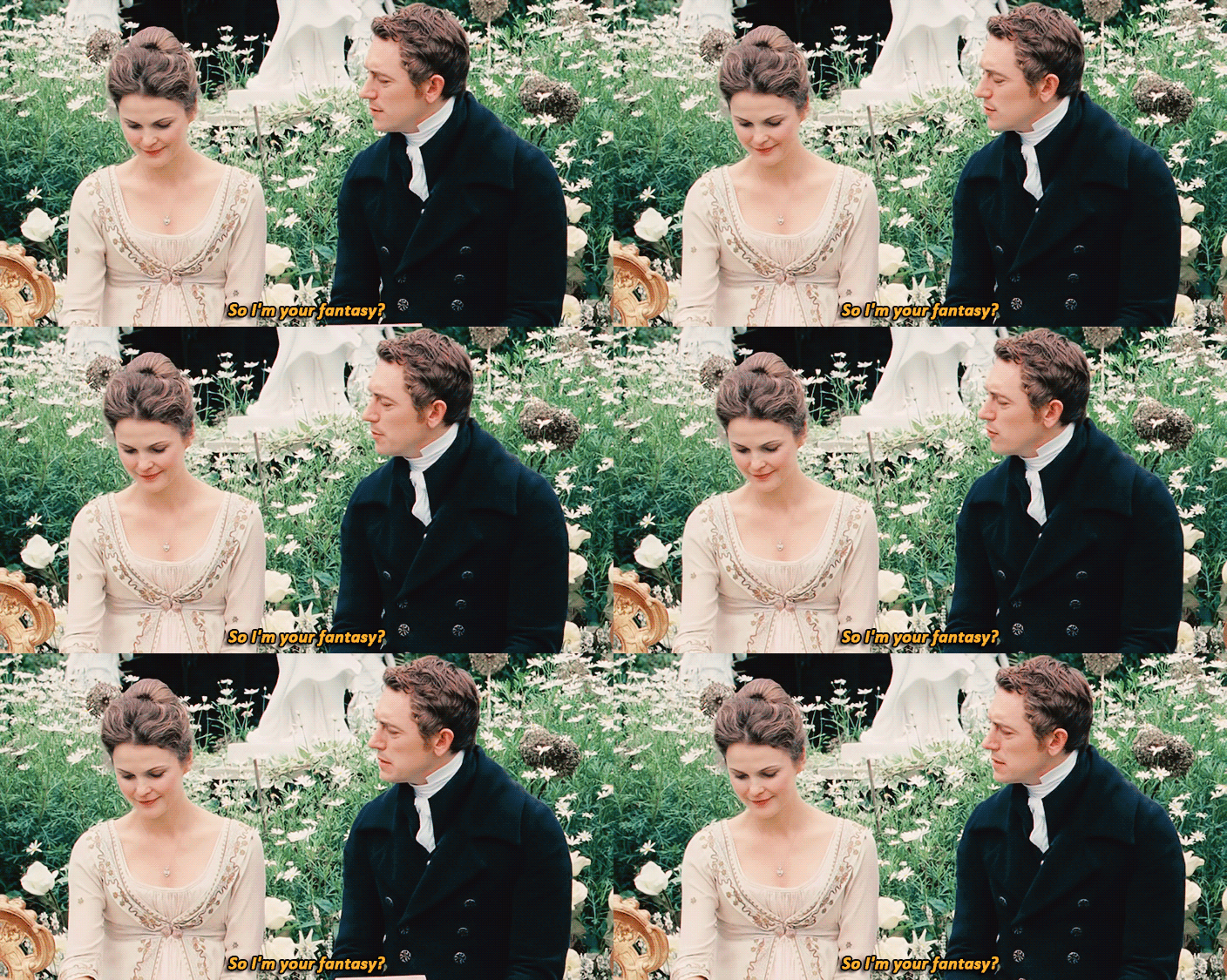
Keri Russell and JJ Feild in 2013’s Austenland

The historical fantasy vs historical accuracy debate has been the source of much controversy across many media genres. Whether it’s regency costume dramas, American westerns or high fantasy epics, there is a tension around who does and does not “belong” in those spaces. On one hand, there is the urge to protect the version of history with which people are most familiar. The American Western, for example, as portrayed by 1950’s television shows like Gunsmoke, The Rifleman, and The Long Ranger, shows a version of the 1870’s and 1880’s almost solely made up of white faces. While we now know that the West was significantly populated with Indigenous peoples, Black folks, Mexican residents and Asian immigrants, it can be hard to shake the “reality” that was shown in those earlier films and movies. At the same time, there is also this drive to gatekeep who has access to historical fantasies. The world of “high fantasy”, for example, as imagined by J. R. R. Tolkien in Lord of the Rings, has often been portrayed in media as having a solely white population. When the casting for the prequel, Lord of the Rings: Rings of Power came out in early 2022, it was revealed that there would be black dwarves and elves in this series. Many white folks on social media were in an uproar over that fact that this fictional world was no longer solely populated by humans and human-like species that “looked like them”. While others have defended this choice citing the nature of a fictional world, the fact that medieval Europe was a multicultural place and that J. R. R. Tolkien did mean for the story to be continually expansive.

Sophia Nomvete plays the dwarf princess, Disa and Ismael Cruz Córdova plays the elf, Arondir in the upcoming series
Lord of Rings: Rings of Power

Now if I turn this over to the world of romance and period/costume dramas, we see very similar dynamics play out. Historical settings have long been romanticized by being framed in an idealized and easy-to-digest fashion as well as being the backdrop for epic love stories. This tradition of using historical backdrops to tell both our heroic and romantic flights of fancy is one of the reasons why it can be really challenging to separate fact from fiction. A biographical picture can have fictional elements, but the ultimate goal of the story is to tell the story of someone’s life as accurately and as entertainingly as possible. The biopic is bound to the historical record and is often a gateway to perceive actual historical events.

Historical fiction/fantasy, on the other hand, is bound to no such timeline. Instead, actual history is a backdrop upon which modern people’s hopes and dreams can be painted. Depending on the piece of media that is created, the historical backdrop can be more or less prominent, but it is still ultimately secondary to the narrative and world that is created around it. There is also a certainty that most of us feel around what we think we know about history, then there’s the fear around learning new perspectives that challenge that viewpoint and finally, there’s the disorientation that can happen when new people play in our fantasy worlds that we have made from our own history.

With this in mind, when we look at historical fiction media, it becomes important to ask whose fantasy is being projected on the backdrop of history and what are their goals in telling this particular story? Equally as important is the understanding that even when a person is creating a fictional piece about their current reality, they are still projecting their views, perspectives and prejudices on what will become history as time passes. The nature of fiction is that its portrayal of reality is graded on a curve. 

Now for better or for worse, historical fiction is also used to educate. Historical fiction can make history come to life in a way that facts and figures simply don’t. It can help immerse the reader or viewer into various truths of the period. In both the United States and UK educational systems, historical fiction media, be it books, movies or television shows, have been used to supplement the teachings of historical facts and shaped our concepts about what a certain time period was like based on literature. No matter your race, background, gender, socio-economic status, ability or sexuality, if you were taught within these educational systems, you received a very singular view of what history was, who belonged in it and HOW they belonged. 

In most tellings of U.S. and U.K. history, it is white people and white men, specifically, who dominate the majority of the narrative. And all children, white children, Black children, East Asian children, Latino children, South Asian children, Indigenous American children, West Asian children, all get the same message when taught the historical record through both fact and fiction, that Western European/White American history is of utmost importance over other historical perspectives. Also, the majority of canonical and “important” literature and history requires white people to be the center of the story. People of all ethnic backgrounds also learn from their education that white people are the most common stand-in for all of humanity, so no matter your race, ethnicity or background, you must always find a way to relate to the white people in the story in order to succeed. However, it is rarely the case that the white children in your school must relate to someone that looks different than them in order to succeed in their literature and historical requirements. 

So with all of that in mind, the selective history and literature we’ve been taught in school, the history of historical fiction media and the nature of modern-day projection onto the past, we come to what this blog post is really about: People of Color and Period Dramas.

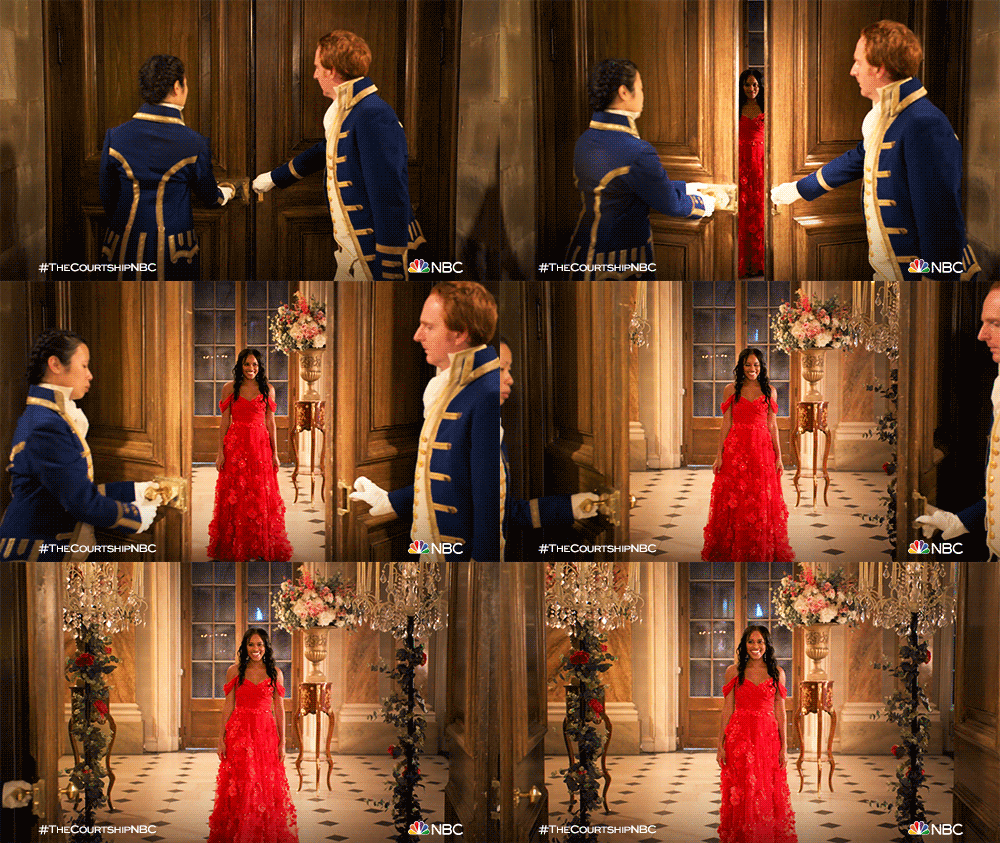
Nicole Remy in NBC’s The Courtship

I, as a Black woman, have been a long-time Austen fan. I devoured so many period dramas in my late high school and college years. I’m a huge Shakespeare fan as well, admirer of Charles Dickens and have the utmost respect for Upton Sinclair. I do not claim to have read all of the “western canon” classics, but I’ve read enough to be considered well-read in many circles. My education also introduced me to Hemingway and Steinbeck, J.D. Salinger and William Golding’s Lord of the Flies. I say all this to say that I, and many others like me, have had decades of practices relating, connecting, understanding and empathizing with characters that look nothing like us, that don’t reflect our lived experiences and whose realities are far removed from our own. And yet, these are stories I’ve come to love and appreciate. The practice of connecting to characters who have a different lived experience extends into the general practice of consuming media because for many years the majority of books, movies or television shows featured the majority of white people in the most important roles. I, like many other people of color, consumed this media which both told us interesting and compelling stories and also implicitly told us that people like us don’t belong in the story. 

In the past ten years or so, there has been a much louder call to include BIPOC stories, actors and producers in more historical fiction media. And more specifically, to also highlight stories that feature our joys as well as pains. For longest time, if a person ever wanted to see a Black person is a historical piece set before the 1950’s, you were restricted to see a Black person whipped, beaten and brutalized because people’s imaginations for a black person could be in the past was limited to being a slave or servant. Going as far back as Gone with the Wind (and even Birth of a Nation, but we don’t talk about that one) to as recently as 2019’s Harriet , we get black people serving or/and suffering as the main narrative. The history that had been taught and media that was provided showed that there were no other possibilities available. But the historical record actually says that Black lawyers, doctors, sea-farers, teachers, nurses and businessman were around long before slavery ended in 1865. But it is hard to picture that reality if it has never or rarely been seen in historical books, television shows or movies. 

This is Virginia Hewitt Douglass (1849 – 1889), a black suffragist in Boston and daughter-in-law to Fredrick Douglass. This photograph and many others like it can be found here as the digital collection of the Boston Athenaeum.

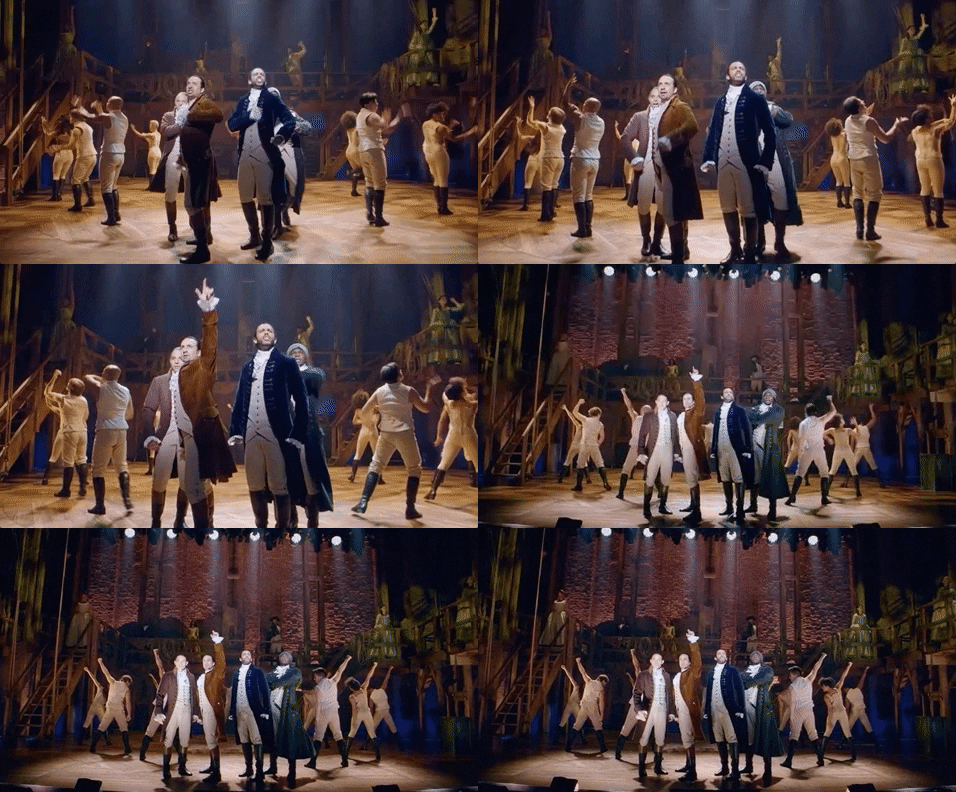
In 2015, when Hamilton came on the scene, it was both bound by the historical record as a biographical performance piece and was a modern day projection onto a historical background. What Lin-Manuel Miranda did was project modern-day New York City onto Alexander Hamilton’s life story. Lin-Manuel Miranda has said that the musical Hamilton was inspired by the 2004 biography Alexander Hamilton by Ron Chernow that he read while he was on vacation. In the origin story of what would become an international phenomenon, we go back to the practice of a person of color using skills of connection and empathy to relate to a person from the past who has a completely different lived experience than they do. For me, and I would guess Lin-Manuel has a similar process, when I imagine myself in the stories that I read, I don’t change my skin color, hair texture or features in my imagination. In the world of my imagination, the world of the book bends around me, so that I can seamlessly fit in and be the hero or heroine of the story. What Lin-Manuel Miranda did was take the world of imagination, the internal story that allowed him to relate to Hamilton’s life, and make it a reality for all of us to see. When Hamilton premiered, audiences saw that you could have an actor of color in historical garb living a life free of ancestral struggle. You didn’t have to see an actor of color present some kind of pain in order to find their portrayal of an historical era compelling. 

Many more period dramas since have included more people of color with subjects ranging from biopics like Small Axe and The United States vs. Billie Holiday to historical fantasies like The Personal History of David Copperfield and Bridgerton. And with that greater inclusion has also come the backlash. In that backlash, some critics have fallen back on what their first education taught them: that people of color don’t belong in history except as slaves and servants and people of color are not main characters in literature. This belief, while common, is, as I stated before, inaccurate and untrue. Some critics when to comes to historical fantasy and literature have said when a formerly white character of wealth and influence is now played by an actor of color, questions around the source of that character’s wealth and the role that colonialism, slavery, genocide and imperialism played in that wealth come the forefront. There absolutely is a place for sources of wealth and status to be investigated in historical fiction media and acknowledging the interconnected oppressive systems that create a character’s wealth and comfort is vitally important. However, if the only time this conversation comes up is when an actor of color takes up a previous white-casted role then the conversation is not about bringing justice to people previously excluded from the story; it becomes another way to keep actors of color out or give them additional burdens that no one else has had to take on.

However, I do believe that more burden should be placed on the writers and producers since the conceits that created the comfortable world for the white character are not the same conceits that are necessary to create a comfortable world for a character of color. For instance, in Hamilton, one of the biggest conceits to make the world comfortable for a Puerto Rican Alexander Hamilton to live in is that he cannot be the only person of color on stage. Another conceit is that this version of Alexander Hamilton is explicitly against slavery in both written and spoken words, but there is no mention of how real-life Alexander Hamilton also bought and secured slaves for his sister-in-law’s marriage. 

Miranda grew up conscious that there were no lead roles for him in the musical canon: he could be a side-kick, or a bad guy, but not a hero. ”…

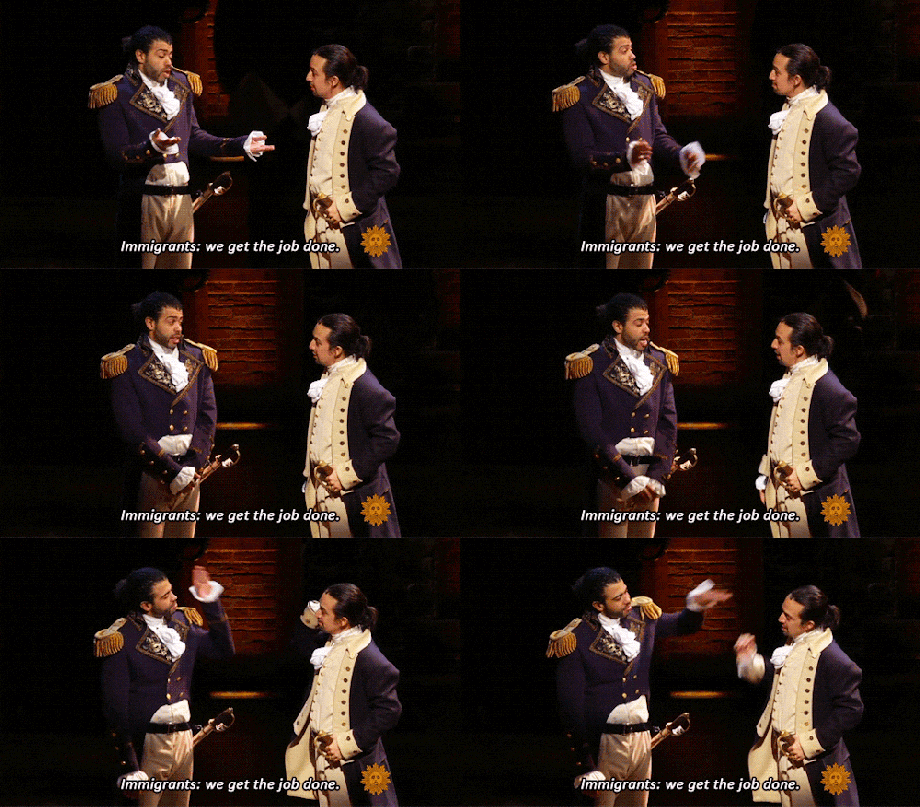
In Hamilton, Miranda has created a world in which this “other”, whether by ethnicity or personality, takes centre stage. Daveed Diggs is a half-black, half-Jewish man who played the Marquis de Lafayette and Thomas Jefferson in the original Broadway cast. “I’m a black man playing a wise, smart, distinguished future president,” he told an interviewer in 2016. If he’d seen such a character as a kid, he confessed, it might have changed his life. “A whole lot of things I just never thought were for me might have seemed possible.”

Hooton, Amanda. “’Our Own Form of Protest’: How Linking Hip-Hop and History Turned Hamilton into a Surprise Hit Musical.” The Sydney Morning Herald, The Sydney Morning Herald, 21 Feb. 2020, https://www.smh.com.au/culture/theatre/our-own-form-of-protest-how-linking-hip-hop-and-history-turned-hamilton-into-a-surprise-hit-musical-20191223-p53mj8.html.
Daveed Diggs and Li-Manuel Miranda in Hamilton

The imaginary world can be and must be adjusted for people of color to live in the fantasy AND people of color have every right to live in a historical fantasy as anyone else. We have read the books, watched the movies and played the games the same as every white person that has felt so seen by the omnipresence of white folks in media that their representation has become the default expectation. What we are seeing in having people of color in period drama is the claiming of spaces that have always belonged to us and the manifestations of the stories that have been in our heads for generations. Colonization has forced us to speak the language, wear the clothes, and consume the media of our oppressors for so long that we have as much claim to it as anyone else. And it is our right to project our dreams and wishes on the past with as much or as little trauma as we choose. For those who cling the argument of historical accuracy in a fictional/fantasy world as the basis of their debate, it seems to me that the real problem is that some people are now forced to empathize and connect to someone that has a different lived experience than they do and, as opposed to those of us who have had to do that our entire lives, others are out of practice.

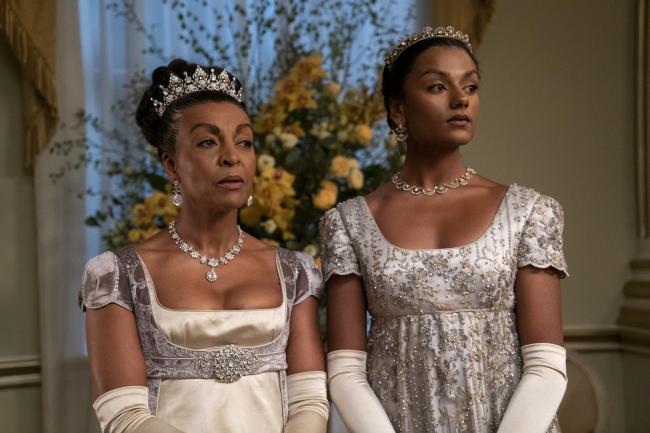
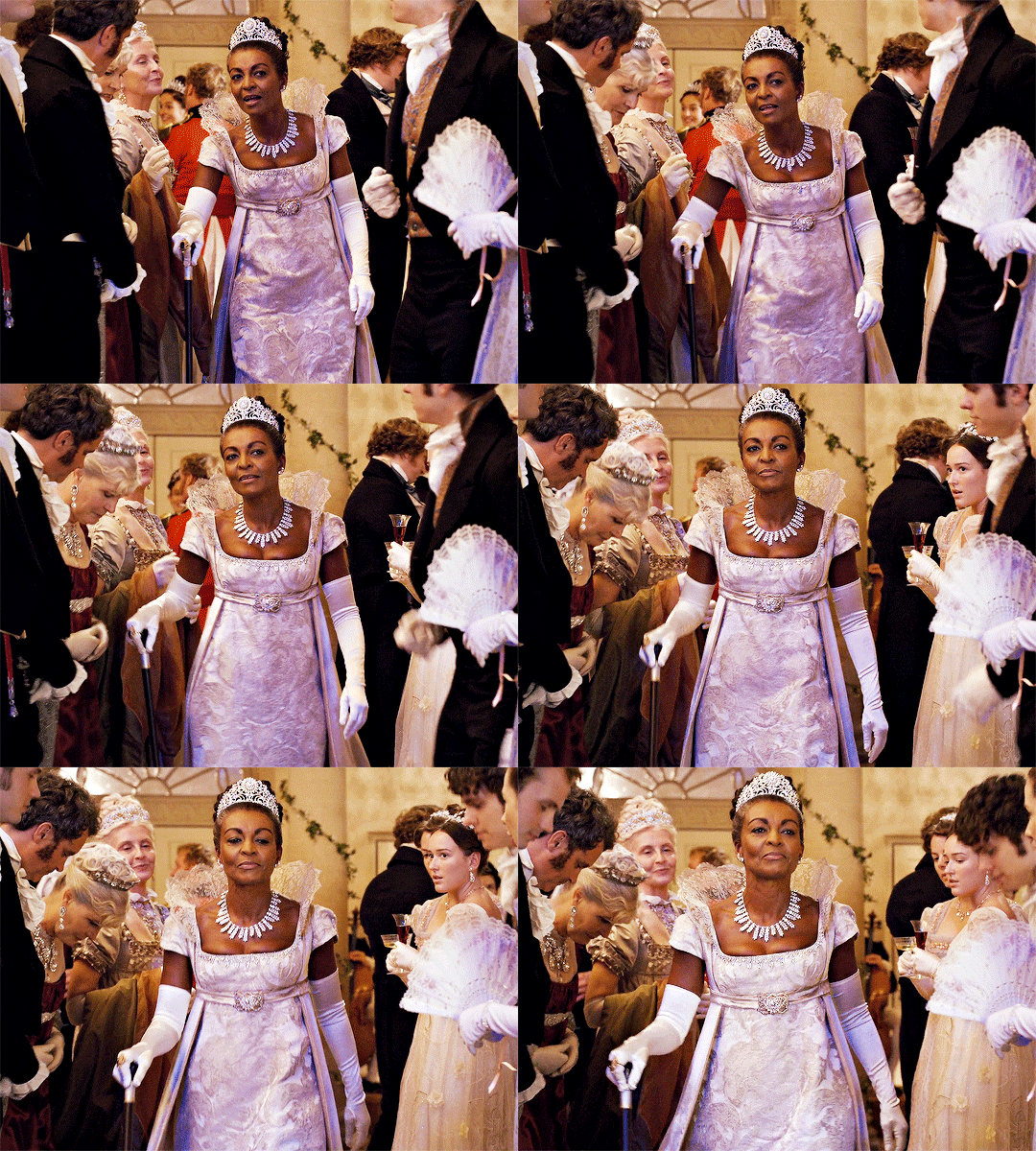
Lady Danbury as played by Adjoa Andoh in Bridgerton.

Interspectional Rewind: POC and Period Drama

POC and Period Drama Interspectional

In this episode, pop culture journalist, Amanda-Rae Prescott and historical fashion and beauty blogger, Ayana of The Vintage Guidebook, join me to discuss Bridgerton, Hamilton and diversity in period dramas. We also take time to examine the fandom community around period dramas as well as diversity of the production and writing teams. So tighten your corset and put on your best hat because we are about to take a turn about the room with this juicy conversation. You can find Amanda-Rae Prescott's website here and her articles here. And on Twitter at @amandarprescott You can find Ayana at https://thevintageguidebook.wordpress.com/ as well on social media at @vintieguidebook

The second episode of my podcast is called “POC and Period Drama” and in that episode, historical costumer, Ayana of the Vintage Guidebook, pop culture journalist, Amanda-Rae Prescott and I talk about the period dramas we love with great excitement. The summer that 16 year-old me borrowed the Pride and Prejudice (1995) boxset from the library, it was OVER for me. I was in love and there was no turning back. At that point in my teenage years, I was already an active reader and a lover of romantic relationships in television and movies where the female character was smart and witty and the male character was able to keep up. Mulder & Scully of The X-Files, B’Elanna Torres and Tom Paris of Star Trek: Voyager, Max and Liz of Roswell; those were my ships. So when I discovered the cleverness and wit of Pride and Prejudice (as well as having already taken a liking to Shakespeare), I was taken in by everything in this fictional world. The costumes, the grandeur, but, for me, especially the language. 

The webseries, Black Girl in a Big Dress, is a pretty fair depiction of how I saw myself as I read Jane Austen books and consumed other historical romance media.

As I grew older, I sought out more and more period pieces, but particularly, those based on literature; this included all of the Jane Austen adaptations, North and South, later Poldark, Copper and Ripper Street. Now it surprises no one that very few of the 1990’s and earlier period drama adaptations had people of color in them unless slavery was the main subject. The 2000’s through the 2010’s saw more representation until the huge watershed moment that was the musical, Hamilton opened the floodgates in 2015. With Bridgerton being the phenomenon that was in the winter of 2020, the conversation around people of color in period dramas has expanded to previously unseen proportions. But also the conversation around the presence and safety of fans of color in both physical and online spaces that celebrate these works has been brought to the forefront as well as the authors and writers of color who have previously been rejected or ignored in the historical drama space. 

A quick summary of the racist drama in historical fiction/period/romance space includes that time they tried to blackface classic literature to get children to read it, when racism caused the Romance Writers of America association to implode, that time with the Jane Austen Society of America also imploded due to racism, when the Charles Dickens’ Christmas festival ignored the safety of their black castmates, and fans of Sanditon wanting to use an emoji with racist connotations to support the show.

Also, there was that time that the former plantation that had been hosting a Jane Austen convention for years want to include more explicit discussions about race, power and slavery during Austen’s time and the fans decided to shut down the event instead of learning and the time that Jane Austen Museum in England also wanted to expand the discussion around race and slavery (which Jane Austen wrote about in Mansfield Park) and some people were not happy. These are some, but not all of the racist controversies that have happened over a less-than five year period. 

But despite all of that, money, viewership and social media engagement talk, and by those metrics, producers have figured that having people of diverse racial and ethnic backgrounds in period dramas sell. And some producers, apparently feeling the call of conscience, also decided to address slavery, racism, and colonialism directly in their historical drama adaptations. These decisions also caused their fair amount of controversy. But despite the presence and concerns of people of color “invading” some white folks’ self-insert historical fantasies, the inclusion of people of color and the diversity within the fandom is here to stay. However, the historical drama fan and criticism space has been almost exclusively focused on white people for so long that all of the BIPOC participants who are now and have been vocal in this space know better than to expect that racist people, actions and commentary will go quietly into that good night. 

So when the Bridgerton-inspired reality dating show, The Courtship (which features a Black female lead), Bridgerton, Sandition, Call The Midwife and Outlander all announced that they were premiering their seasons in March 2022, I sent out this tweet:

BIPOC Vampire Day

BIPOC Vampire Day Interspectional

For the last episode of Black History Month 2022, we end as we begun: Celebrating Black Joy.  We are talking about BIPOC Vampire Day with its founder Jamila aka @BlackBettieCosplay. BIPOC Vampire Day (well, weekend) took place on September 17-19, 2021. For this weekend, cosplayers and artists of Black, Indigenous, Latine, Middle Eastern, East Asian, South Asian and other POC backgrounds embraced their “dark” side and dressed up as vampires and various creatures of the night. As movies, television and media have embraced vampire lore over the past few decades, people of color have often been left out or left with minimal representation, with #BIPOCVampireDay, Jamila sought to change that as well as bring a community of diverse, creative people together for a good cause. In this episode, we discuss the inspiration behind BIPOC Vampire Day, how event developed and where it is going next. I hope you enjoy it.

Episode Transcript

Latisha: Hey everybody. And welcome back to season two of Interspectional, the place where we have nerds talking about nerd stuff through a social justice lens. That is my new tagline. I hope you like it. Today I’m super, super excited because today we are talking about BIPOC vampire day. First day that this happened was in 2021 in September. Super exciting event.

And I have with me, the person who created it all. So could you introduce yourself, tell us a little bit about your fandoms and a really, really, really quick intro to BIPOC vampire day. 

Jamila: So hi, I’m Jamila of Black Bettie Cosplay. My fandoms are wide and vast. So anime, a lot of Disney, Marvel, various indie comics, some D+D stuff.

Kind of just like if it sparks my interest and it’s usually in the fantasy/sci-fi end of things. I’m here for it. Vampires are its own subsection of obsession which is kind of how I ended up making the event. I feel like I was talking to some various friends and we were always complaining about how there’s just not much rep.

Despite how popular vampires have become on movies and TVs and stuff lately. Like the rep is still incredibly low. Like it’s crazy how little you see, as far as diversity, when it comes to the characters that they create. Like, I can maybe name a handful of shows that actually have POC characters as not background characters, but lead characters that happen to be vampires or just villains or anything.

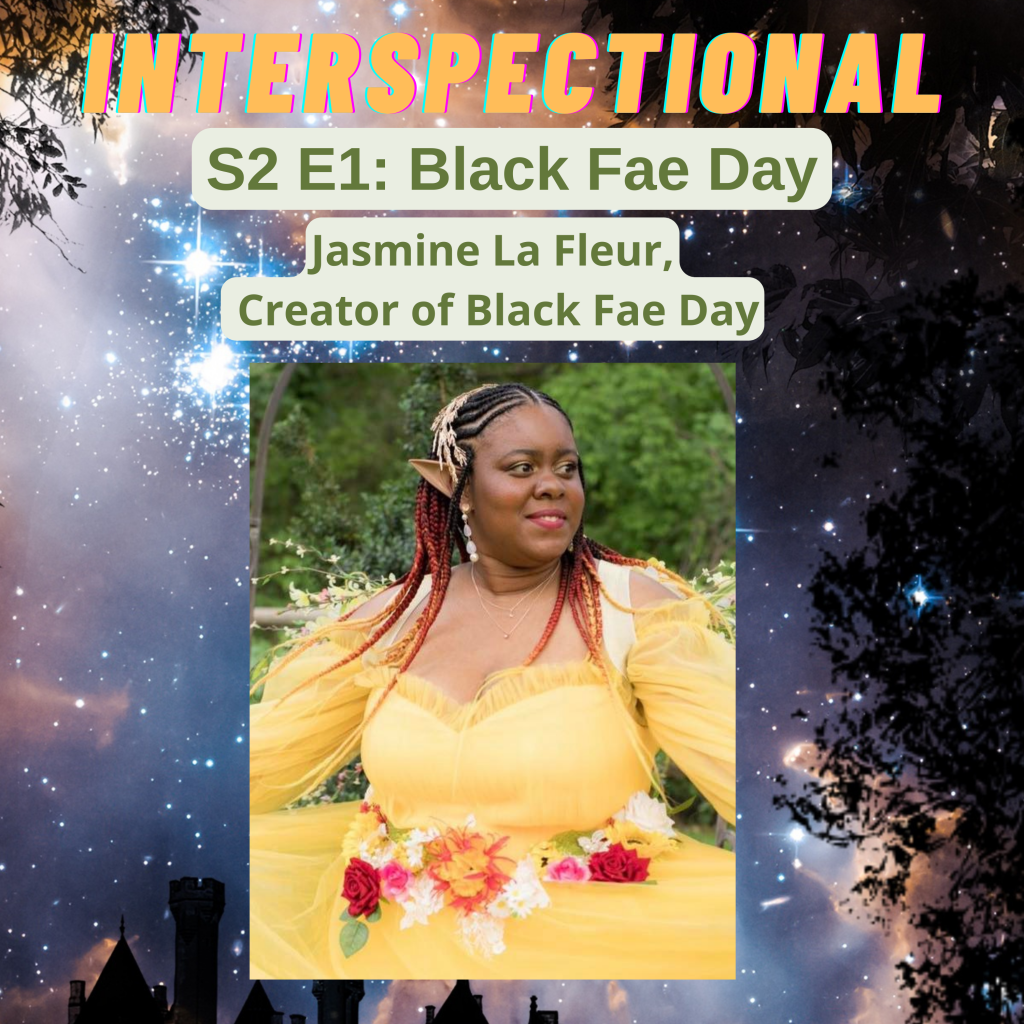
So it’s really small and Black Fae Day happened and it was amazing. And I was like, what if I made a vampire day? Like, why not? That’d be really fun. I’ve wanted to do it for a long time, but it was kind of like, “Ooh, the momentum’s there. People are like hungry for it.” And so I was like, “Yeah, let’s do this.”

 Let’s have a BIPOC vampire day. And so that’s kind of how it started. And it was September. It started out as I think a weekend. And then it became three days. Yeah, it was a lot of fun. 

Latisha: That’s amazing. And I’m glad that you mention kind of like some of the impetus started around Black Fae Day because I remember I found out about Black Fae Day late.

Like the day of is what I found out about it. And I saw all these amazing pictures and wings. I was like, this is my exact aesthetic I’ve never seen in my life. And this is it! Why did I not know about this earlier?! And so when I saw BIPOC vampire day, I was like, “Oh, this is like the dark side of that same theme.”

And so that was. Super super exciting. And you mentioned the representation, and that was a part of the story of how this was created. So what surprised you the most about people’s reactions? Cause I know you put out the “Here’s what we’re doing” months earlier.

So what was that first reaction of like, “oh, this is happening?”

Jamila: I think how much excitement there was around it. I mean, I knew it was gonna be some excitement. I had a feeling cosplayers would want to get involved because it was like, “The cosplayers are bored. We have no cons. We need something to do.”

But just like having all the people who had other forms of media, like reaching out. Like I had a bunch of people who are doing gaming related stuff, who were like, “Hey, what if we did a bunch of calls for games that happened to be more centric around BIPOC vampires?” And I was like, “Oh my God, that’s exciting.”

And all this stuff started coming out. I mean, I obsessively follow vampire projects. So I was already like reaching out to people. I already followed for their other vampire projects were like, “Hey. There’s an event coming.” But just generally, how surprised I was about how many people were willing to just jump into it and create little mini events around it, because I announced that it was happening after Black Fae Day had finished. But I didn’t have the dates u ntil like June or something. So it was still very like, kind of last minute as far as like planning it, because the main thing for me is I want it to be a fundraiser and a charity event, because I was like, “If I do anything vampire related, I really want it to tie around some sort of blood something cause blood drive.”

 And so once the dates were all set, I just expected it. “Okay. There’ll be a little bit of excitement.” I didn’t think it would blow up quite so much. And that there’d be like not one fundraiser, but like four fundraisers all happening. And that we were able to kind of work together in the last minute to make it this big, like event full of stuff. Like we had streaming that was going on.

There are games being created. It was… definitely a surprise. I didn’t expect to see all that happening at the same time. So that was cool. 

Latisha: Yeah. So can you elaborate a little bit more on like the fundraisers? What they were and how they tied into the event? 

Jamila: So yeah, I wanted to do something tied to some sort of something to give back.

Cause I was like the events that have been happening are really cool. And I was like, “I don’t want it to just be like, oh, I dressed up in a costume and that’s it.” I was like, we’re getting all this attention to it, so we need something. Like, representation was already kind of happening. It’s like Black Fae Day started pushing that like already.

So that was good. So I was like, “Well, what’s another thing that can be brought into the place?” Like not just, “Oh, Hey, you should consider us!” But something else. And so for me, I was like, “Well, sickle cell anemia is a blood disease that affects a lot of POC is significantly more than anyone else.” And then I was looking on the website of a couple of the national organizations and they’re like, “Oh, it’s September is Sickle Cell Awareness Month.”

And I was like, “Oh shit. Like, I didn’t even plan that.” I was like, “Oh, well now it’s meant to be like, clearly it was supposed to be in September all along.” I didn’t even have a clue that that’s what was supposed to happen. So I was like, “Okay, well now I have to make up a fundraiser for the event and they can be linked to forever.” So that was one of the fundraisers that was going. Another group I think, was doing it for Lifewater. Cause I think they had set their stuff up before they we’d kind of gotten to communicate about it. And so another gaming group that was doing a lot of the streaming. They also did fundraising f or the Sickle Cell A ssociation of America as well. 

So we had two of them kind of running simultaneously side by side, and then we had another group that was doing charity water at the same time. So it ended up turning into something where you’re going to have excitement and we were also going to be able to give back, plus I had a lot of people who were not POC who were like, “I want to help somehow.” And I was like, ” They can share.” But I think some people really liked the fact that they could also help donate and support and have it go an extra step. So that definitely was like, saw some really good traction for people who just wanted to find their own way to get involved.

Latisha: I think that’s so cool. And I love this like communal aspect of the entire event. And I have another episode where we’re talking about vampires and talking about in essence, the way they are primarily portrayed in media is not just folks who are usually white, but also of the upper echelon in many ways, both literally in the text and figuratively are somehow taking away from society or way from somebody’s life.

 I feel like in many BIPOC communities, the community growth and the community concern is one of those things that’s more primary. That’s more like put forward. And so I love with the fundraisers is that you get to put the community in the, like the vampire aesthetic was really cool and it should be inventive.

And it really helps the enjoyment of this work also feel very grounded in different types of people, in different types of cultures and backgrounds. So like I just found that it’s so cool and so interesting. Were there any particular like characters or stories that were in media or in television or books or movies that influenced these celebrations specifically or influenced you as someone who liked vampires?

 Was there like a particular series, like, you know, Was Vampire Hunter D on your list? You know, you have made an entire statue of Alucard somewhere? Like you never know. 

Jamila: I mean, they’re all, they’re all like on my list. Like my first encounter, I think when I was a kid was. Yes. When I was a kid, I’ll admit that was I think finding Vampire Lestat like, that’s that book. I think that was the first one I read out of order. And just like becoming obsessed, but I also read like a lot of folklore, which like had like vampire aesthetics and stuff, but I read plenty of elf things. They kind of similar elements to them. So I’ve seen some people say like, “Oh, fairies and vampires aren’t really that different.” I could have like a long discourse just on vampire lore… Don’t get me started. So yeah like, Alucard. Vampire Hunter D. Like all of that was just like (eat it up). Basically I was like, look up like vampire anime, just like, “What do you got? You have anything new that I haven’t watched yet. Please give me! I need that sweet vampire content!”

 So, I’ve consumed a lot or at least whatever is immediately available. There’s still tons I have not even had a chance to look at. That’s also I think where the… The disappointment comes in because it’s like, there’s just so little. Like, I was super happy when they redid Castlevania and they had some representation in there.

Thank you. But it’s still like, so small and far between, or there’s more movies you see that will include POC in vampire stories. That’s the key thing here is that they’re still rarely the vampires. They’re always like fighting the vampires or whatever, but I’m like, “I get it.” Most of the narrative, we tend to see vampires are rich. They’re usually taking away from society. They’re a curse. They’re awful. So I get why that tends to leans to like, “Oh, well we’ll just make the vampires the oppressors because that’s just like the obvious place to go.” And so you see that storytelling often done and I think that’s probably why it also so heavily leans towards tending to be white people. 

 I think in books, they’ve done a better job of exploring it. So you find more books where you have vampires of color like stuff by Octavia Butler and whatnot. It’s not just telling one version of the story. And it’s funny, cause I was looking up some more books for inspiration.

There’s like one, I haven’t had a chance to read, but like some of the earliest vampire stories, one was actually about a slave that became a vampire and then use that power to get revenge on their slave master. And I was like, “Yeah. Were those, were those movies, please? Where’s that?” Because it’s a version of the whole concept of a vampire that like someone who didn’t have power is getting power and is using that power for their benefit.

And you almost never see that in stories, especially the character tends to be white and already in a position of power. Maybe they might be poor and they use it to ascend, but you don’t see it always extended to the other groups. And so I have noticed that trend a little bit more when you do see those stories is that is how it tends to be used.

In fact, there was an Amazon one, which I’m not going to recommend because I didn’t love all of it, but there was like one of the villain characters that was his villain origin stories. He was like, “We were working for the slave masters.” But then they became vampires. And so their whole goal was to up and the power system.

And I was like, “Yeah, that’s smart.” Like, I mean, why not? Why wouldn’t you do that? You’re given power. You didn’t have, and now you couldn’t like use it to your benefit. Like that’s so smart. So I would like to see more different stories explored. And I think that’s why I was so interested in trying to encourage people to get them, because I know so many people who are like, “Oh, I want to do this vampire, but I’m Indian or I’m black. And people are going to give me crap about it.” Like immediately, they’ll be like, “Why are you doing that? Vampires are supposed to be pale or vampires are supposed to be European or something like that. “

 And so I know plenty of people who want to tell these stories or want to create these characters and have literally been told they shouldn’t because of just the vibe always being a certain look, unless it’s like the five vampires where we were like, “There’s Blade! There’s Akasha”

I’m like, there’s probably two more, but it’s not a very long list. Like in True Blood, they had the black vampires. They weren’t the main characters, but they were in there. They’re like, “Oh, ah, the ones with Twilight.” And I’m like “Yeah, he was only there because of the director.” He wasn’t even supposed to be black. Putting that out there, I’m salty. I have many, many feelings.

Latisha: Many people share those feelings and those salty feelings, unfortunately, and I know this is going to get me somewhere, but like I did not watch all of the Twilight series. I didn’t know. I knew that I know that there is a black vampire. I would guess that he has a total of maybe 10 lines. I could be wrong about that. 

Jamila: No, he has like 10 lines. It trust me, you didn’t miss it.

Latisha: I was just guessing. I was just guessing. But what’s really funny. And I know I’m going to keep on referencing the previous episode, just because we did the exact same thing about slaves or, you know, formerly enslaved people becoming vampires and how that would essentially up in the entire system. And if you already had vampire in that system? Well, no, they’re not going to turn the slaves cause that upends a system that’s already working for them. I was like, “Yo, what if, and I’m going to repeat the same thing I said before. And I was like, what if like Nat Turner right before they hang him? Boom. Vampire!” 

Jamila: I know right! It would change everything! Part of my obsession is I’m working on my own story and comic and whatnot. And I was like, “You know what? Think of how much, like you could really change history?” It’s not to diminish what was done historically, but I was like I have a Haitian character. And I was like, “What if some of them were vampires? Maybe that’s what helped them win. Maybe that was the turning point.” And I was like, “Yes, that’s her original story. Okay.” 

Latisha: I’d be like, “That French vintage taste good, don’t it?”

Jamila: I freaking love it. I love it. I love it. I love it. I love it. 

Latisha: Well, also speaking of vampires, for whatever it’s problems, the one that people don’t talk about much, but it’s a solid horror movie is Vampire in Brooklyn

Jamila: Yes. 

Latisha: Which I feel like one of the reasons why I didn’t do as well as it could have is cause people were expecting a comedy, and they actually got a modernized version of Bram Stoker, which they were not expecting. But if you watch it just for what it is, it’s like “This is actually interesting.” And then how Eddie Murphy does take the vampire story and fuse it with a more black, Haitian Afro-centric narrative, and it’s really interesting.

And it’s like, how do we take these stories… Cause one of the things that I find interesting, whether it’s vampires, werewolves, et cetera, we’re all, especially if you’re American, we’re all inundated with the same stories. And I feel like people forget about that. I’m like, “Yeah. Alice in Wonderland. Wizard of Oz. I was raised with those things as much as you.” 

Jamila: Yup. 

Latisha: So being that, that is as much in my psyche, as anyone walking down the street. I also feel like I have like my own level of, “Yeah, this is part of my culture.” And yet I also have another aspect of my culture and I might want to either blend the two or modify or do something so that, you know, I can see myself expressed in the culture that has literally been forced on me since birth.

Jamila: Yup. Yup. 

Latisha: So it’s really fascinating. And you mentioned, people who participated, who were of various ethnicities, where they were Indian, Asian, Latinx, et cetera. And have you seen anything from a variety of cultures with BIPOC vampire day or anything that someone said like, “Oh my gosh, I always wanted to do this, but I’m Indigenous and no one knew what to do with me, but I can do this.” 

Jamila: I definitely saw it. Actually someone gave me a little bit of flack about like, “Why it wasn’t specifically just black?” And I was like, ” No, because here’s the thing. It’s mostly just white vampires. There’s not really much diversity at all.”

And it kills me because as somebody who loves folklore, like I’m obsessed with folklore. I have read so many different versions of vampires. I hate to break somebody’s bubble, but Bram Stoker is not the first person to invent vampires. He didn’t do that. He just took folklore and mythology and superstitions that already… 

Latisha: Not even his folklore, by the way. 

Jamila: NOT EVEN HIS FOLKLORE! It’s somebody else’s folklore. Somebody else’s folklore and turn it into this thing. And so people are always like, “Oh, Bram Stoker”. I’m like, “Yeah, but he didn’t make vampires. Stop it!” And I tried to bring it up a little bit with the event. I’ll probably push it more next year. There are so many takes on vampires, partially because malaria and mosquitoes are everywhere. Not even kidding. That’s like part of the reason, that’s it. That’s why there’s… 

Latisha: And bats. No one likes bats. 

Jamila: And bats. Bloodborne disease and flying creatures that drink blood, they exist. So you have ones that are like, there’s some really cool ones that are Aztec vampires. You have like the Aswang in the Philippines. They have ones that are specific to the Caribbean. Like I grew up with stories of old hag. No, they’re not always like a literal interpretation of what we accept as vampires. Like sometimes it’s like the line crosses with witches and fairy and all sorts of stuff, but there’s still very clearly blood drinkers.

The key thing here. There really is so many different ones. And that was one of the really cool things is some of the people I saw post would give some of the backstory of their cultural vampires, you know? From various walks of life, because some people are like, “Oh, there’s this native blood drinker.”

And they brought that up and they shared that story as they did their makeup or their inspiration. It’s like, anything you wanted to do, you could like pull from your history. You can just make something up. It doesn’t matter. And that’s why it was really cool. As you got to see all of that come about and people got to see that and go, “Oh, maybe I should read it to that more”. Like, “Oh, I didn’t know. There was like a vampire native to this place. That’s so cool.” And so it’s like all of a sudden you don’t have everybody like, “Oh, vampires can only be these five things”. Nope. That’s not how it works. 

It’s just a very simple rule. That’s it. And then you can do whatever you want. It’s just a fantastical creature. You can have fun with it. And so it was nice to get to see people find themselves in that character, whether you like vampires or not, whether the villain or not. They could find their place and how it relates back to them. And that’s what I wanted. 

Latisha: Yeah. I think that that’s so amazing and so fascinating. And also there’s something to be said about like a particular culture’s monster or variety of monsters, you know? And I also feel like, you know, we end up in globalized society, whatever you want to say. So many things end up being homogenized and to being commercialized so much of it is whatever our folklore version of folklore is.

It’s interesting that yes, well, many of us want to connect to the heroes of our cultures. There is also something to be said about the monsters or villains that are specific to our cultures as well. It’s kind of like, what are we afraid of? Or what do we know that others don’t or, you know, Even if this is kind of the dark side, this is a dark side of me, right? And all of that matters. So that’s just really cool and really interesting.

 You mentioned getting a little bit of flack, but have you received any other like negative feedback? And if so, how did you deal with it? 

Jamila: I don’t think I really got much. I mean, I think the only thing that people were like, “I didn’t know this was happening” and I was like, “I don’t know what else I could’ve done.” I’m like, “I announced it like in May. Kept talking about it forever. I don’t know.” 

Latisha: The internet is large and vast. 

Jamila: This social media life is rude. It’s cruel. So I’m like, I mean, the nice thing is there’s going to be, it’s going to happen in next year. So I’m like you’re being notified right now. And from then on, literally up to the event again. No excuses. But overall, it was pretty positive. Like there really weren’t that many issues or complaints.

I was like, people like vampires, I don’t know many people were like, “Why would you do that? Why would you do vampires?” I’m like, “I don’t know. Cause they’re cool. Leave me alone.”

Latisha: Cause they’re cool. Cause they’re interesting. Because I decided that that’s what we’re going to do. 

Jamila: Yeah.

Latisha: That’s awesome. So what do you hope that people will get out of celebrating these days? Whether it be, you know, vampire day or Fae day, I hear mermaid day is happening next year. So as one of the people who’s helped push this forward, what do you hope people get out of it?

Jamila: I feel like a sense of community, cause like, it’s definitely nice to see like, “Oh, Hey, all these people like this thing too. I have new friends maybe.” But also just like seeing the creativity and the drive. It’s been a rough couple of years and I know a lot of people need deadlines or just something to look forward to.

And so that’s kind of been the nice thing, like whether you participate or not, you’re like, “Ooh, I get a day where my feed is just flooded with this, whatever this thing is, mermaid.” So exciting, you know? And so I feel like there’s a little something for everybody. If you’re like, just looking at it, you get something neat to see for one day, if you participate, you get a show off.

Sometimes it’s the first foray into doing something for anybody that was like, “I might not cosplay, but I sure like vampires or I sure like cows I’m going to do a cow thing.” And that’s the first time they might do something, but they’re going to get to have fun, you know? And it’s like a little Christmas. You know, you open up and you have that day were everything super exciting. I feel like we could use as many of those exciting days as possible. And it’s nice to have a day that’s about celebrating instead of mourning or just being upset or angry. Cause there’s plenty of that. I’m so angry. I want to be excited and make beautiful things. And so it’s kind of nice to have an event where that is the goal: is to make something beautiful, to contribute, to help, to find new artists to follow. And it’s just a positive thing that we just need. So it’s been nice to have those like little moments of positivity throughout the year 

Latisha: Absolutely, absolutely. I can totally see that. And what advice would you give to someone who is interested in participating, but it’s like a little unsure. a little intimidated. They’re like “I saw all these wonderful things on my feed, but I could never. I will just admire from afar. Beautiful people. “

Jamila: I’m like, if you want to do it, just do it. There’s no like prerequisite, it’s not a contest. Like this is just about getting involved. And the nice thing is almost all these events have little ways to get involved. A lot of them are open to artists that like, “Oh, you wanted to do some art.”

Some people do art. Some people do art of other people participating. Like there’s all these little ways. If you’re a photographer, find somebody who needs a photographer for their costume or some other thing. There’s like little ways to get involved. Like I’ve seen people be like, “oh, I’m gonna make a comic project for this.”

And it’s like, “Yeah, just find your thing.” Someone made a video game. I was just like “What in the world?” Someone made a DnD game with vampires. Cause they’re like, oh, this event’s coming up. The nice thing is so many of these events are so open-ended, you can find something to get excited about and be involved in.

 But there’s no high requirement. So it’s like do as little or as much as you can. And if you can’t do it that year, if you know they’re going to have another year just prep for the next year and take your time. Cause I definitely like had some where I was like, oh, I want to do it. I do not have any time.

So I’m just going to share every single person I see. I’m gonna just keep reposting everybody. And that was my way of contributing is I was like, I’m just going to like everything and comment and share all the stuff so I can look at it later. So yeah, I feel like it’s like, don’t be pressured.

Don’t feel pressure. 

Latisha: I did the same thing where it was like, share ,comment, share, let them know. I love them. Engagement, engagement, engagement, because I want this to come back.

Jamila: I know it’s like, give them all the love. That’s the most important thing.

Latisha: And I personally think like Like you never know, who’s going to see it for better, for worse.

So many of us spend so much of our time online now. And I still feel, even though there has been more than many of us, many people of color who are creative and our interests and all these different things and who feel very isolated. You know, am I the only one in my friend group who was interested in this? Am I the only one in my block? Am I the only one in my school? 

And so just knowing that there are other people out here who are into similar things who are grown-ups, who were into similar things who are, you know, successful in our own right. And just saying, “You know what, I’m going to go out and have fun.”

And just knowing that there are other people out there like you can be so encouraging. 

Jamila: Yeah. 

Latisha: You know, so it’s just one of those things of like, “Yes, let’s celebrate.” And speaking of, you know, the games and all of this and you’re moving into next year and I’m going to ask you to share the date soon, but not quite yet. Is there any media or more media being built around vampire day? Like is there a TikTok series web series, you’ve mentioned comic books that people made, the DnD game.

Jamila: Yeah, there was a lot of submissions or just art and makeup looks and projects. And so I’m trying to get that updated so that people can kind of see all that stuff for inspiration for the future. Someone was making a diverse vampires book of like six or seven illustrations that a bunch of people had done to inspire people for future character building and design.

There was a slew of games that were all made by one group. They had people submit various role-playing games and tabletop games. There were some video projects that were shared with me. Just so many things that people were just like, “Oh, it’s my time to shine!”

Latisha: I’ve been waiting for this all my life. 

Jamila: Give me all of your vampire things PLEASE! (eat it up) Let me support you. I think it also just energized people to see that there was a demand and a need. And so It’s good because I think there’s so many times where people probably pitch something and just were told, “Oh no, no, one’s going to be interested in that. Just do the same old, same old.”

And it’s like, “Oh, well, here’s an example of how people had no interest in just the same old, same old. They wanted to see all this new stuff.” And so it’s been really good to just like, have all that, just to get that it’s like,” Ooh, people would agree. They want it.” 

Latisha: “They want it. They see it. I’ve got to have it.” 

Jamila: So, yes, there is so much that has been created and I’m trying to like, get it all showcased so people can also see all the different places that they can support all these projects. So yes, so much came out of that. It was so mind boggling. 

Latisha: Fantastic, fantastic. So we talked about next year, but also, you know, where do you see this going? What do you feel is like the future of specifically BIPOC vampire day or just in general, this kind of interest in diverse fantasy and including, people of various cultures and backgrounds and kind of the fantastic lore that is presented.

Jamila: I’m hoping that it will start getting more people, seeing that in the widely known media, that it’s okay for them to have more representation and not just on the sidelines, but in the mix. You’re starting to see like more TV where they have diverse groups of people like mixed race families, all this sort of stuff.

They’re starting to be like, okay, these projects are like, people want to see them, but it’s still. Still far reaching for fantasy and stuff like that, because they’re like, “Well, we got to put a lot of money into that. ” But there’s you starting to see the shift just a little bit, like even on Amazon, I think Amazon, Netflix, just the fact that they started having more POC led fantasy movies, like just appearing.

And I was like, “oh my God, it’s happening finally.” It’s like, “We want this too please!” So it’s like all of these events, they see it. I mean, I hope they’re seeing it, but they can’t miss it. Hopefully, they start realizing that there is an audience for this. There are people who are craving this.

They’ve been craving it all their lives and we can’t just keep churning out the same boring stuff they’ve seen. It’s fine. But we want to see a little bit more diversity. The world’s diverse. Let’s see it. And so many books have existed for so long with so much diversity already in them. They’re just like, “Well, let’s just make Bram Stoker’s Dracula for the 80th time.”

I mean, I love the story, but there’s like a bajillion stories out there. Can we like tap some of those? So we’re starting to see more of that happening. And so that’s good. And I hope that momentum keeps going for the event. Like next year, we’re hoping to just get more prep and have more streaming content, just like some things that people can enjoy online.

And again, the fundraiser is still going to be happening. Just ramp up a tiny bit. Not going crazy. I’m excited that all these events keep bringing so much joy to people. And like the representation that isn’t seen in the media is finally getting shown somewhere else so that little kids can see it.

Adults who never got to see it can see it and they can be like, “You know what? I wasn’t weird for liking Lord Of The Rings and wishing I could be in it.” I’m not weird for that, because look at all these other people, they felt the same way. And maybe one of those projects that people hype up during those event days will actually get greenlit because there’s so many that are looking for funding and these are the events that help them get that funding because they’re getting directed right to their audience.

So I’m hoping that more and more, we’re going to see that shift and it’s going to change because it’s time. It’s way overdue, way overdue. So– 

Latisha: Yeah, I love that. I feel like there’s almost like two levels when it comes to the type of engagement. I feel like there’s the wide media landscape. There’s Netflix and Disney and the folks all the money who makes the things and the stuff that gets sent out there into the world.

But then there’s people on the ground floor on the level of like, “Hey, usually I’m a fan, but no, I create my own stuff too, or I know my fandom community. I know the people that I hang out with and here’s what we’re doing to encourage ourselves to make us happy. And if Marvel or whomever is not going to do it. No worries! We can take care of ourselves to make ourselves happy.” And that’s the plan. So I love that you’re doing that. I love that you’re part of this conversation and moving the story forward. So the moment that I hope you listeners have all been waiting for.

When is 2022 BIPOC vampire day? Please tell us. 

Jamila: So it is going to be in September again, and this time it’s going to be September 23rd, 24th and 25th. So one week before October starts. 

Latisha: All right. So put that on calendar. September 23rd, 24th and 25th of 2022. You can get an early prep Halloween costume. So that’s what we’re doing that weekend. You know! You have all this time to get ready. Thank you so much for joining me here on Interspectional. I’ve enjoyed this conversation immensely. I hope my listeners have as well.

And can you please tell people where to find you on the interwebs websites, social medias, et cetera, et cetera, et cetera.

Jamila: So I go as @blackbettiecosplays, pretty much everywhere on Instagram. There’s an S at the end. And on Twitter, it’s really weird. It’s @bbettie_cosplay and it’s Betty with an I E not a Y. On Tik TOK Facebook, Instagram, Twitter, all over the place, pretty much. So follow me. 

Latisha: Yes. Follow her, follow BIPOC Vampire day. Follow all of the wonderful, homegrown fantasy media that you will see in 2022 supporting people of diverse backgrounds and diverse audiences, also known as the global majority. If you don’t know that phrase, learn it. And we’ll see you again.

Or hear from you again next time on Interspectional. So everyone thank you so much for listening and have a great day.

Women of Color in Sci-Fi TV (2015 – present)

Women of Color in Sci-Fi Television (2015 – present) Interspectional

Since 2015 (and a little bit earlier), there has been a massive increase in the amount of women of color that we see in sci-fi/fantasy media across network, cable and streaming platforms. With this increase in representation (and we can always use more), the conversation has shifted a bit more from just putting women of color in speculative properties to exploring how we are being represented and what are the overall messages being send the audience. In this episode, I explore those ideas with transmedia social justice producer and co-host of Trek Table, Claudia Alick and Community Advocate and co-host of Pop Chatter podcast, Natacia Knapper. We look at #StarTrekDiscovery, #Watchmen, #LovecraftCountry, #Flash and so much more. It’s a fun, intense, definitely going-to-challenge you conversation.

You can follow Natacia on Twitter @nknapper and you can follow Pop Chatter Podcast on Twitter at @PopChatterPod 

If you are interested in learning more about the Baldwin House project follow @DCW1MutualAid


You can follow Claudia on Twitter @Callingup and you can follow Trek Table Podcast on Twitter at @Trek_Table

If you are interested in learning more about Watch Nights and F*** The Gala, go to www.callingupjustice.com 

Episode Transcript

Latisha: Hey everybody. And welcome back to Interspectional. I am super, super excited for this particular conversation because we are talking about women of color in sci-fi television, but specifically from 2015, up until the present. Now, if you listen to some of my first episodes, I explained that me doing the Woman of Color in Sci-fi Television panel is how I got started.

I did that at Awesome Con. I did that at BlerDCon. It went to Dragon Con, somehow without me, but that’s another story for another time, but when I’ve done those sessions, they primarily focused on TV shows from like the 1960s up into the present up until that point. And there’s a lot to cover, but there’s not a lot at the same time because you’re talking about one or two women of color showing up in these types of media per year for a long time or maybe five or six as we get into the 90’s and the early 2000’s. And around 2015, there was an explosion.

We saw women of color in sci-fi on the Syfy channel and on networks and on streaming, especially. And that is its own thing, I feel. Yes, an add on to this long legacy, but also just this new territory that I find is really interesting to investigate. So I am really excited to have these two guests with me, as we talk about, this new phase in kind of representation, what does it mean?

The types of things they’ve created and what we hope to continue to see in the future. So I’m going to have them introduce themselves. Natacia, could you go first? 

Natacia: Yeah, of course. I’m really excited to be here. Again, my name is Natacia. I’m happy to finally be talking with you with Latisha. I feel like you’ve been trying to get me to come to one of your panels forever and our schedules just never seem to be aligned.

So I’m glad that it finally happened. And I just have so much to talk about. Again, yeah. My name is Natacia. There’ll be a time for me to talk about socials and plug all those things later. I’m sure. I am a black femme non-binary and yeah, I have a podcast where I talk about Marvel stuff and all kinds of other things.

So yeah, I’m excited to really dig into it with y’all. And, yeah, happy to be here. 

Latisha: Super excited to have you here. I’ve actually been on three episodes of the Pop Chatter podcast, which one half of the hosting team Lindsay being the other half, it is always a fascinating conversation. So I am super excited to have her with me.

And yeah, I’ve been trying to get her for a long time. So I’m like, YES! Finally! Claudia, please tell us about yourself. 

Claudia: I am a transmedia social justice producer and a lifelong scifi and fantasy mega-nerd. And I’ve always had these real deep thoughts in my head about it and have struggled to find a community, to communicate about the things with around science fiction.

And it’s only been in like the last decade where I feel like I could have, not only the conversations I want to have, but hear other people having them, which has just been amazing. So thank you so much for having me. I identify as a disabled non-binary black female AFM, and you can reach me at callingupjustice. com and then you can also check me out on Trek Table podcast, talking about Star Trek Discovery. 

Latisha: Trek Table Podcast is so much fun. You hear so many unique perspectives. So I highly recommend that podcast. And for me, puts me in a space where I’m thinking about science fiction more deeply. All right. So my first question to the both of you is in the past seven years or so, what has been your favorite depiction of a woman of color in sci-fi/fantasy and why? So we’re talking 2015 to the present. 

Natacia: So I do have two characters I would like to name. The first character is actually May. Agent May from Agents of Shield. So that’s definitely 2015 on. But the show technically starts in 2013.

I don’t know if that’s cheating, but I would say that May is probably, just like one of my go-to female characters in Sci-fi and like in a comic book world. First of all, Agents Of Shield was definitely like straight up sci-fi. When you get to the later seasons, they weren’t even trying. It went into space. It got wild. Like I’m telling you. People, if you’re just looking for a really good sci-fi show, I think it’s okay to skip the first two seasons and just go deep, just go right into the space with them. But anyway I digress. May, I really loved because she has such a great arc on that show.

 They really start her off from a place where she’s really leaning into some of those tropes that you see with strong women. Where it doesn’t even feel like this is like a woman or femme character, it feels like it is a male character that they are just giving a female identity too.

 This is such a standard trope that we see all the time. I think it’s something that you in particular see with women of color, but they really allowed May to be a more and more vulnerable character as she opened up, as she built this community, as she became more part of this family. You saw her actually grow and learn and become more emotional through the people and the relationships that she gains. And I was having a conversation actually on my podcast where it was focused on like the women of Star Wars. Where it is very rare that we see women allowed to be vulnerable and strong at the same time. I feel like it’s either one or other, or we define strength in being like physically strong.

And there isn’t like strength in vulnerability. I just think that May, especially in the later seasons, this was a really beautiful balance of both. And it was just so kick ass. I just loved watching her fight people. It was really great. You have no idea how many times I’ve gone onto YouTube just watching scene after scene of May just kicking people’s asses. 

Claudia: Fighting herself! Do you remember the one where she was fighting herself! Come on. 

Natacia: So good. Some of the best fricking fight choreography. I just really loved, loved her. 

Claudia: Have you see her on Boba Fett? 

Natacia: Oh, I could talk. Sorry. Don’t get me started on the Book of Boba Fett. I am a Star W ars person but May! A bsolutely incredible! Love her in Agents of Shield. Ming-Na Wen. Just I’ve loved her ever since street fighter. 

Latisha: I feel like she has like the franchises that I love, like not even a trifecta and there’s an EGOT for you are awesome at everything you’ve ever done and completely beloved. She has earned that. I’m just like you just need to name it after her for everything that she’s done. Here’s the thing about so much of her work. And this is also why I think a lot of the stuff is important. The chances of people getting Tony’s, Golden Globes, Oscars for any of the Sci-f i TV work, even in some of the Disney animated work or whatever, super unlikely, like they don’t touch any of that stuff.

Rarely anyone can tell you who won the Oscars or golden globes, five years ago. We can all pretty much tell you at least one scene that we remember in Street Fighter. Like those are the things that stay with people. And yet, somehow our society says that those things don’t need to be awarded. And I have major questions about that, but I digress. And you said there were two, Natacia. 

Natacia: Okay the second one, I’ll be a lot more brief. The second one I feel like this might be a little maybe controversial, but Regina King’s character in Watchman is another character that I absolutely love. There are aspects of that character I struggle with and we’ll dive into that a little bit more later, but her depiction of Angela /Sister Night is just so moving. It is a performance that I actually think about all of the time genuinely.

Like it’s one of those things where again we have a strong female character who’s just allowed to be deeply vulnerable, deeply emotional. And that’s actually where she gets a lot of her strengths from. For a show that really delves into the trauma of being a black person and the history that we have to live with as being black people in this country, she managed to move into this role in such a way where she was able to really fully own her power as a black woman, while also not being defined by her trauma as a black woman. It was just such a beautiful and balanced performance. Honestly, anything that Regina King does. But that performance is one that has stuck with me. And I revisit more than I do most shows, but yeah those would be my two choices. 

Latisha: Those were great and I love that detail. Claudia? 

Claudia: This is a fun conversation. So I struggled to give you an answer partially because I struggled with favorites and picking one, but also because I feel like there’s actors that I deeply love. Even as I find the cultural productions, they are inside of problematic on different levels.

For instance I love Gina Torres in Serenity. Oh, she is so good, but I could never mention that cause it’s complicated. Also so many of these actors who I love are always playing an assistant or a helper or a best friend to a centered white person, usually some centered white dude and I’m like I’m not sure I like that story. So I’m going to name my girl. Sonequa Martin-Green! Sonequa Martin-Green! Captain Michael Burnham! I love Captain Michael Burnham. I could name the actress that plays Owo on there is so good as well. Michelle Yeoh is amazing.

Natacia: Oh My God, Michelle Yeoh! 

Latisha: We already knew like Michelle Yeoh was a legend of just incredible proportions, but the range she is allowed to have on Discovery. All the characters really, but like Georgiou is just so fascinating and hilarious. There is no reason why this murderou s woman should be that funny. Like freaking hilarious. And also you just look at her sometimes you like, “I don’t want to say you have a point, but you might…” 

Claudia: And the chemistry between these actors. These are actors that are so good at what they do. It’s a delight. It’s not only a delight to experience the storytelling that you’re getting.

It’s not only a delight to get the scifi beats that are fantastic and amazing. And the fight choreography. Oh. But just a tense piece of dialogue between Sonequa Martin-Green and Michelle Yeoh, so delicious. So yummy. Just the best. 

Latisha: One thing I actually want to mention because I absolutely enjoy Discovery as well. And the levels of the journey that Michael Burnham goes through, I find incredible. And the different ways family is defined and redefined and questioned is rather incredible. And can I talk about yes, much has been talked about Michael Burnham having natural hair in space, but the fact, and spoilers if you haven’t seen it, the fact that the last couple of seasons sista-girl has braids. I’m just.

I don’t know, like outside of maybe Martha Jones and I have questions about that, but I don’t remember actually seeing like braids and protective styles like that anywhere. On top of that, you know what this means? Do you know that Michael Burnham has braids means? That there is a braider in the future! Like someone got the hair and lit the fire underneath the braid. Or put it the hot thing of water. And like they’ve got hair oil in the future. Hair oil! 

Natacia: That’s so exciting.

Latisha: I’m just saying. And even though it had its problems, I really enjoyed Jurnee Smollett’s performance in Lovecraft Country, like there are levels. So many levels to that too. Her performance stuck with me in many ways, not just ” Ooh, that one gave me shivers”. But it was also amazing to me. Even, I thought in the first episode or the second, when they finally reveal like the monsters in that episode. The fact that by the time you get to the monsters, that it’s almost a relief. 

 It’s like by the time it gets to the strange grotesque, whatever. It’s like “Finally, something other than the human monster that I’ve been having to deal with.” It’s this moment, which I feel is so specific and I feel like you have to have lived that in order to write that. It’s like, how can the appearance of a multi-fanged, tentacled whatever, be like, “Oh, finally!” Like, how do you get to that moment? You make something in real life that’s scary. And you finally moved to the fiction part and you can let something go, which is just like an epic piece of storytelling to me. 

Claudia: I have to admit, I have missed out on the amazing performances and that particular cultural production. I wanted to watch it. And I was like, “Oh, this will trigger all of my PTSD.”

 I’ve tried to approach it a few times. I haven’t been able to experience the trauma that’s involved. I feel like it’s a traumatizing experience to watch the show. And I really want to, so I’m hoping that a few years, maybe when there’s less racism in the world. 

Natacia: It’s feels likely

Latisha: I actually want to hit on that cause I feel like that is a legit experience specifically with black media or black focused media, because some of the things that get put out you’re like “I would like to, but this will hurt me.” ” I would like to, but this will be a problem.” And the advantage of often looking into science fiction is to explore themes with a bit of remove.

So you can get some of that space and yet talk about these things. Granted, we were talking about sci-fi from 2015 to now, but if you were going to go all the way back to The Next Generation, specifically, a lot of the Data episodes. They’re talking about agency and they’re talking about whether this being is property or not. They’re talking about these things. I wonder what analyses we’re going for here, but yet you can look at them with a sense of remove. You can look at it without saying “I am re-traumatizing myself in the process”. And that can sometimes be the advantage of sci-fi.

Claudia: That makes me think about how back in the day, they didn’t allow us to be in anything. Blackness was erased, but blackness is interesting and amazing. So it was sampled and culturally appropriated to make the whiteness actually interesting. That’s why Data is interesting. Data is there because they can’t actually tell stories that actually explore the fundamental questions about disenfranchisement of human beings. Having an entire class of human beings who aren’t treated as full human beings. You think they could do it with Geordi, but they didn’t do it. So anyway, I do want to get back to 2015.

 Like I’ve noticed that once you center a black person in the story, you can’t speak in code. You actually have to have some things that are just black, that aren’t a metaphor for blackness or the black experience. 

Latisha: There’s no metaphors to be had. Culturally, I feel that many people in the black community are fairly direct. Just linguistically. I will tell you what I’m thinking. I’m telling you what I’m feeling.

I do not have time to be passive aggressive because there’s so many things going on because the amount of brain power taking me to not say what I really mean I could use for something else like survival, which is not necessarily the case in other linguistics styles. So it’s an interesting concept.

And actually this leads into my next question, because thinking about it for the longest time, the call, when it comes to media, has it been like “representation matters”. And now it seems to somewhat evolves into like “authenticity matters.” Because even as we’re seeing more people of color, I feel like there’s even more of a call of “Is this person actually person of color?”

“Is this person actually a black person?” Are we seeing those linguistic markers or is this someone, who you just put in this role and didn’t take into account all of the culture and history that they were bringing to them. So I wonder if that’s being pushed, what does that mean if characters of color get “messier”, or if we have more villains. Are people ready for that?

Natacia: Yeah. So I’m gonna touch on Watchmen again really quick and say that I know that this is like an unpopular opinion, but I am actually a pretty big fan of the show “Lost”. I feel like nobody’s willing to say that. 

Latisha: In spite of it being a cultural phenomenon that everyone was into at some point in time. 

Natacia: That show really was that girl back then. I’ve been a big fan of that show and Damon Lindelof, who was the showrunner of Lost for the majority of its run after JJ Abrams left. There were a lot of issues with the characterization of black people and other people of color in that show. There’s so many examples, I don’t even know like where to start. The fact that one of the only main black male characters they leaned into the deadbeat dad characterization, the fact that they got another black lead character then killed them off on screen, like in the most violent way I could imagine.

I think about that death scene all the time, it was so violent. And while that show was like violent in moments, it was just… It glorified that death in a way that was very disturbing. So many problems with the way that they wrote the Asian couple.

There’s so many things that went wrong, but what I actually do think is really important is that over the years, Damon Lindelof has had other projects and over time he is actually in a strange way, learned from a lot of the cultural mistakes that he made with Lost.

So by the time we got to his creation of Watchmen, he was very intentional in creating a writer’s room that featured a lot of black writers. And it was very clear that black writers were involved because of how black people were characterized on this show. Now, I will also say that I love the conversation of authenticity and allowing black people to be villains and to allow them to be complicated people. That we’re not putting black people into one simple archetype or recreating the same types of characters over and over again.

But what I worry about is when I look at the conversations that we’re having on social media. The commentary that I see in different online spaces, I do think that black characters and other characters of color are actually critiqued in ways that white characters aren’t. When I look at the way that people had so much grace for a lot of other male, white centered Marvel characters, for instance, but the level of dialogue and critique that was like happening around Shang-Chi was frustrating at best. And expecting a level of , not perfection, but I think we all know that people of color, black people in particular, but people of color have to meet a certain threshold of being able to do everything right. To be the best at what we’re doing. To always make good choices. And every time our choices are even a little bit faulty. I feel that the critiques are so much harder. And what I worry about in expanding and having more complicated characters, even though I feel like that’s necessary, I think that the conversation is going to be hard and toxic for a while still. It doesn’t mean that it shouldn’t happen, but I think we should be prepared to experience a level of, I don’t know, If the word is like backlash that I want to use, but I do think that it’s going to be harder to excuse the behavior, I guess. If that’s the best way of putting it of people of color who are doing things that many white characters have been doing for many generations in sci-fi TV and movies. 

Latisha: Doing for many generations and still beloved. I feel like the villain who we stan for, the villain that we appreciate and say,”Oh my gosh, they’re such a mess, they’re my favorite.” Like having that character be a person of color. To have that character who was that messy upon mess and be someone who’s not white. Okay, during the pandemic, I’ll admit I had a Vampire Diaries moment. Are we ready for a black Damon Salvatore? I don’t think so. And then he gets everything. I’m just saying.

Natacia: To be honest, people love Lando Calrissian, but I don’t even think people are ready for a show that totally centers on Lando Calrissian. Because it’s not just going to be this like fun black man that is like going around, getting into hi-jinks. He’s going to be doing Han Solo shit. And I don’t actually think that people are ready to allow black people to show up in that way without critiquing them to death. 

Claudia: This is what you brought up for me. For a long time, we were in a casting paradigm where there can only be one. Now, this is partially economics. They don’t want black people to get paid. You’re not gonna have a black lead cause the lead gets paid the most. And also that the cultural production is reinforcing ideas about whiteness, which is why you can have sexy, evil white dude. Why? Because American culture wants us to have really good feelings about sociopathic white dudes with lots of power. They want us to feel so good about them. They want us to be like, “Oh my gosh, you’re being genocidal and destructive, but you’re so sexy and hot. I hope you get with Rey.” The thing right in American culture. So that’s why, and this is the Spike versus Killmonger paradigm or the Damon versus Killmonger paradigm. They will give us characters that are sexy, brilliant, that have an amazing argument. And then they will make sure that character does something so awful and horrible that we will have to write off everything good about their argument.

 Killmonger is persuasive, except that he kills his black female partner. I don’t remember the name of that actress, but I was excited cause I was like, “I wonder what she’s going to do? What’s going to happen with ‘Oh, she was a prop for the narrative to force us to hate him and to also dismiss all of his arguments and go for the more centrist politics of Black Panther.’ Okay. Okay. All right, Hollywood. I can’t forget that Marvel at its core is imperialist storytelling.” I am here for it and I love it, but it is what it is. 

Natacia: Yeah. The imperialist storytelling of Marvel is just so wild. I don’t know if you watched Falcon and The Winter Soldier, but when I tell you the end of that show,

Latisha: I think there’s a difference. There’s the end of that show. And then there’s the end of that show because there are two separate endings, one I enjoy. And I like very much, and one, I have many questions about, so you gotta be clear. 

Natacia: Okay. What I am talking about is the show did a really clear job of presenting John Walker as this again, the sociopathic, violent, this sort of flag waving guy and what was really wild to me is they really presented him as such an extreme antagonist to the two protagonists of that story. One of them being a black man in America, and the fact that one, at the end of all of this like, antagonistic back and forth, they were like, chummy by the end of the story for literally no reason. Nothing had substantially changed.

John Walker hadn’t really adjusted any of his behavior or how he was showing up. And yet everybody just pretended that everything that had happened for the last seven episodes had not happened. I thought I had missed an episode somewhere. Like it was so wild.

And then the pinnacle for me was at the end of the day. I love what you’re saying about needing to present like these black, revolutionary type characters as a problem as they’re like against what we should be striving for or what we should be trying to be.

And the character of Karlie who, her motivations were very like weird. Whatever, writing issues. But like at the core of what Karlie was trying to communicate was a large inequity, a violent inequity that existed. And how she was dealt with at the end of that story is wild. And the fact that Sam’s big moment in dealing with that at the end, was to give this moderate, neo-liberal, like speech at the end where 

Claudia: Falcon America is a cop!

Natacia: The fact that he was just like, yeah, let’s all just sit in a room together. Let’s all just be friends guys. Like he is a cop and like he is so pro military. It is wild. It was wild to me how they presented that. And then at the end where he takes the other black super solider we were presented with and perfectly happy by seeing that there’s a little display case for him in a museum.

And he’s just “Oh, wow. I’m so glad. I’m getting this recognition in this museum. That’s really, all I needed” was the inference and like what we were seeing in that scene. Like what I’m trying to say is, there is a very sinister way in which Marvel moves and how they present their stories.

And while I love Marvel, I have a whole fucking podcast devoted to talking about Marvel. I think it’s really important that we are talking about how these things exist in our media because that’s how we get better writing rooms. And that’s how we like push studios to do better job of representation behind the camera.

Latisha: But I also have something to add really quick because we’re literally talking about double consciousness in reference to the media that we consume, which I think is utterly fascinating.

 This idea I am able to appreciate when I’m watching on a” just tell me a story and I’m along for the ride” level. At the same time, I am watching it under the context of “this is how this would operate in the world that I actually live in.” And not only how the actual story would operate if it was real, but also this is how this story is actually operating in the world that I am in.

And so it is this like multilevel understanding of story which only certain people have to do. Also what I find interesting is that I know me when I enjoy various pieces of media, it’s like I have to turn on and off certain dials. It’s like, “Okay, for me to enjoy this, my activist dial has to go down.”

You’re just like “Please don’t do something so egregious that I have to turn it up. Please! I can deal with a lot. And if you just don’t go over the edge, I don’t have to burn this to the ground.” And then… but sometimes they don’t. But, and then… 

Claudia: I find all storytelling produced by dominant media to be sinister. So it means that I’m watching it and enjoying what I can enjoy, because I want to be a part of the world and enjoy things. But I’m the person who was just like, “This is so good. It’s also the devil, but it’s so good.” And that’s what it is to live in this country.

 My opinions are a little extreme, but I can tell when a white person wrote a storyline and a black person cleaned up the words, so it sounded plausible. It used to be, it was only white people in the room. So you could really tell when a white person was writing words for a black person to perform, and now the rooms are often mixed.

 I feel like I’m saying the same thing, but I’m loving this storytelling coming out of Star Trek Discovery. It feels like that’s a room that’s having some battles. Where there’s some people who were like, “Oh, we could get away with doing this and it could look like we are serving a black audience when actually we’re serving what the white people in the writer’s room really want to have happen. What the white producers really want to have happen.” And it feels like there’s enough black producers with power and also like enough aggregate numbers of us there.

It’s not just two writers in the room, two black people trying to hold the line who have precarious job positions. So I’m in full agreement that we have to have extraordinary diversity in the writers room, but also like in the producers as the folks who are writing the checks. This is the only way I get fabulous black female representation that I don’t have to turn my brain off a little bit, every 20 seconds to still be okay with it.

Latisha: It all goes up the line very much. And for those of you interested in learning more about television writers and what they go through, I actually have an episode about that called “TV writers Advocating for Authentic Stories”. So you should listen to that.

 I did want to piggyback something that you said a while back, Claudia, about that time in scifi television and especially much earlier where a woman of color was often like the one in the group or the one on the team.

And now I’m seeing more fantasy, particularly books, not always TV and media, but I’m seeing more women of color in community. And what do you think being in community versus being somewhat isolated from one culture, changes in the storytelling?

Claudia: Can you help me find another science fiction property to reference other than Star Trek Discovery that has black women or multiple groups of women of color in community? 

Latisha: Fast Color. I would say Lovecraft Country. Black Lightning

Claudia: Okay. Yeah. Yeah. 

Latisha: And Naomi, which is, just started, but Naomi, I still feel counts. 

Natacia: It’s really good. I like it. Just started it. And it’s really good 

Latisha: Batwoman. Look at counts or there’s more than one. 

Claudia: You saw my eyebrow just…

Latisha: I know. I saw. But there’s more than one and they do talk about quite a couple of things. And 

Claudia: Okay. Wait. Okay. 

Latisha: It took them a while to have more than one black woman on Flash. It took… Okay, I have a specific Candice Patton question toward the end, but if you want to talk about… Okay, you can literally see like Iris West’s trajectory from the beginning of Flash till now. Like crosses this entire time period of ” We’re going to just throw this black actress out there and see what happens. And leave her to the wolves” to “Wait, you mean, we actually have to consider this person?” “Oh, you actually have to consider the storyline.” “Oh, we actually have to consider their culture.” “Oh, you need more than one person.” “Oh, they need to actually have a plot and actually their own storyline.” “Oh, they need to have agency.”

And so it’s an interesting trajectory that covers the entire time span of what is this conversation. Thank you, Candice Patton for sticking around as long as you did. They didn’t deserve you. Neither do we. You never deserved anything you got and you should have more. I hope you have an amazing post-Flash life whenever it ends.

Natacia: Is the Flash still on?

Latisha: It is! 

Claudia: I don’t think it ended it’s storytelling. I think that’s still going on. I just know you’ve got Meghann. And she’s black. You’ve got the Flash’s dad is a black man. I forget that actor’s name, but I love him so much. 

Latisha: Jesse Martin. 

Claudia: Jesse Martin. Woo, I love me some Jesse Martin.

Natacia: Oh, I’m behind. I need to catch up. 

Latisha: Don’t forget his mixed race children who like to show up. So you have Nora and Bart who have shown up. 

Claudia: But also you’ve got the assistant or the former assistant. She was like a lawyer. And then she became she’s doing something else and she’s psychic. And she’s married to the Flash’s dad.

And so you have these amazing scenes. We just have like community. I will say it doesn’t feel like the community scenes that you have in Black Lightning. The Black Lightning scenes are fully black. And I do think that there’s a difference, not only in the kinds of ways that we actually in real life have community, but I will say though, it feels like a Flash dinner scene is blacker than any dinner scene that I’ve seen at any of the other properties in that particular Arrowverse.

Natacia: I will say, I am not as well versed in Arrowverse, but Black Lightning, I watched two seasons and there was, I don’t know, if this is a conversation for this or a conversation for another time. But I would agree with you. The way that community is presented in episodes of the Flash that I’ve seen there’s a closeness and care and an honesty to how folks are showing up for each other in that space.

And Black Lightning is a show I stopped watching after season two. I don’t actually know if it’s still on or how many seasons it had. But my issue with Black Lightning was always the way it represented blackness was in such a respectability lens that I felt frustrated a lot when watching that show.

I don’t know what the writer’s room looks like at all for Black Lightning, but it did not feel like it was like black writer’s room when I was experiencing how black people were engaging with each other and with the outside world. Because one of the things that I really love, and of course, black people are not a monolith, and everybody has like different kinds of relationships that they have with the black people in their lives.

But I know that there is a reality, a realness in how I’m engaging with people in black spaces when we are our away from non-black spaces versus how I am out in like the non-black world. And I just feel like I never saw that in Black Lightning. And I think I’m always suspicious of any sort of writing or representing of black people in community together where we’re not seeing a difference in how they are with each other versus how they are in like the non-black world.

Latisha: I see that. I absolutely see that. And the question is “A re the writers or the producers, whoever is there, are they present, whomever they are, in those spaces?” Do they know what those spaces feel like? And do they know them well enough to replicate it? Do they know it well enough to write it in such a way… Going back to thinking about things linguistically. If you talk about things like overlapping dialogue or cooperative conversation, which is fairly common in both Black spaces, but also various POC spaces also, various specific, European spaces.

You’re talking about people with a Greek culture or Italian culture you have that, and you have that, “Oh, people interrupt. Ah, people are rude.” Nah. T his is how we talk when we’re together. And you just got to catch up. And if you’re not one of those people who’s able to catch up, that’s cool.

That just means that you listen really intently and talk to someone later, but that’s how we do it. And I’ll have five different conversations while I’m getting a plate of food, but you have to have been there to see it. And then you have to experience it to be able to write it.

And then you also have to have the director and the writer to know how to shoot it. So you get that, that feel and that back and forth. And that I’m talking to you, I’m talking to you, you said something silly. I’mma hit you with a pea while talking to this person. And I need someone to zoom in on the pea that hits the forehead. I just, I need that. 

Claudia: Yes. Thank you for doing a shout out, not only for the necessity to have cultural competency in t he writers’ room. We have to also have cultural competency behind the camera and with the editors. I had a very similar reaction to Black Lightning. But it’s a reaction I have to actually 80% of the black shows that are allowed to have cultural success.

They have to follow some rules. I have conservative family members, very conservative black family members in the south, and they love those storytelling beats. They love witnessing black people looking good, having money, paying their bills. They are a fan of cultural productions that I believe serve notions of success through a lens of whiteness that serve white ideas of how we should be behaving, but are in fact racist on a level. That said I feel like Black Lightning is definitely written by, I’m guessing I’m ignorant, but I feel like it’s probably a majority black writer’s room. But I am guessing that the executives in charge of making the choices, they were serving some people who have racist notions about what is and what shouldn’t be.

It reminds me of Sleepy Hollow. And how they made the choices on Sleepy Hollow and didn’t think it was going to destroy their show. Like they just destroyed the bag cause I was watching that show. I was like, “I’m going to be here for you, girl. I don’t care who the skinny white man is. I will learn to love him.” 

Natacia: 100%.

Claudia: And then they just kept fumbling it. And then they got rid of her. That was like, “You don’t understand why I was…? Oh, you don’t want my money. Oh, you don’t want me to exist on this planet Earth. Oh, that’s how it is.”

Latisha: Okay. So Claudia, you do know the entire journey. And I do mean the entire journey of this podcast and of me doing a “Women of Color in Sci-Fi Television” panel starts with Sleepy Hollow. My very first episode, if anyone is going to watch it, (I love to plug these things because I have them) is about Sleepy Hollow for reason because it is this source of eternal rage for most Black women that I know who love science fiction. If you want to make any one of us enraged… I’m not saying violence will happen, but you will see the urge in our eyes.

Why? Because Sleepy Hollow was great. Sleepy Hollow was fun. Sleepy Hollow was enjoyable. We got to see a black woman centered in the story. It’s her entire story for the first season. And then… and then we all started villain origin stories. I’ll just leave it at that. 

Natacia: When I tell you that, one of the things I am haunted by to this day, is I convinced so many of my black nerd friends to watch that show.

I convinced so many people to watch that show. I remember being like midway through that first season and being like “This show is awesome. Telling everybody who would listen like ” Are you watching Sleepy Hollow? You need to be watching the Sleepy Hollow.” And

Yeah. I completely fell off of that show. I like every black person who was watching that show totally stopped after that. But yeah, very disappointing.

Latisha: And speaking of which combining both the ideas of Sleepy Hollow and talking about w hen black people are presented in the idea of like black respectability in Sci-fi. One of my questions is there’s a pattern, it seems of women of color, specifically black women becoming cops and/or the best friend/caregiver of the white character and black men as security or some type of guard in sci-fi/fantasy properties. So what do we think is up with that depiction? I’ve talked about that also talking about Sleepy Hollow and some other things where I’m like black woman is a cop. Black woman is a cop. Joss Carter was a cop. And I’m like “What is this that says that we think that this is the role that is ideal or fairly typical for a black person to take when they are in sci-fi/fantasy properties?” 

Natacia: Earlier in our conversation, I had expressed that one of my favorite characters is Regina King from Watchman. But I think in the same breath that I love her character, that show while it takes a very different tone than I think shows normally do around black police officers and how we look at black police officers, I can’t ignore that is a central piece to her character on that show.

 And, often, when we see a lot of side characters to the extent that you’re talking about both black women and men are definitely treated as caregivers and how a lot of our media tries to soften or have us feel more relatable to police officers through blackness. It’s a really scary and insidious thing that we see. I don’t want to belabor the point again and spend a lot of time, again, talking about Falcon and The Winter Soldier, but that is such a harmful lens and how we talk about policing and how policing shows up in our media.

Because with one breath you try to present this really like violent white version of this police officer, but then Sam Wilson very much is playing the role of a police officer like of someone who is policing. But doing it in the “good” way. And I think that this shows up in our media a lot and it’s really intentional.

Again, it is a way to get us to relate to policing, to be softer on how we look at policing and to get us to be okay with the ways in which we are as a community part of our own oppression or wanting us to play a part in our own oppression and it’s awful.

And I will say while I think we see fewer tropes, clear tropes of, uniformed police officers that are black. Sam Wilson again is not like a uniformed police officer in a traditional sense, which is why I think most people who aren’t thinking too deeply about it, do not look at that as like policing, but that’s exactly like what he represents and he’s upholding something that is really harmful to black people.

Claudia: So the question is how do you produce some white dominant storytelling that’s going to not only maintain the status quo of how the country works, how white domination works, but also what’s going to help stop a revolution. You don’t want people getting notions and starting a revolution. One thing you got to do is you have to sprinkle some black people in there.

You got to have a little bit of black representation or the white domination is really legible and we’re able to call it out. That’s why there’s so many black judges. And black chiefs of police in these movies and TV series, right? This is copaganda. This is also statistically, not reflective of reality.

So it’s bananas that you see so many black judges, black chiefs of police, but that allows you to cast that person and then not actually have them in the story very much. It allows you to have the feeling of honoring and having that character, that actor in there, but actually how much were they actually impactful in the story?

And also what’s the story they’re really telling? The story they’re telling is will actually the criminal justice system is run by black people mostly, who really like it and want to maintain it. It’s toxic and weird, but there’s a reason why the characters we get to play are the characters we get to play.

They’re the characters that are maintaining the mythologies of white domination that the characters are the caretakers. I’m thinking of the show as a Fringe , where Jasika Nicole, she was… 

Latisha: Astrid. 

Claudia: Yeah. Astrid, I loved that actress. She’s a fabulous actress by herself already. But I had such a fondness and appreciation for the character. But also again, I can really enjoy it if I turn off the piece of my brain, that goes, so “They made sure to have this one mammy character, just taking care of everybody, caring for everybody, never caring for herself.”

At one point you get a kind of a sneak into her character’s life after four or five seasons. After many seasons, you got to have her be a full character. I feel like that’s the pattern. That’s why… okay… WandaVision. WandaVIsion… This is one of my anger points with all of comic books because Captain Marvel was a black woman.

Captain Marvel was a white man. And then they were like, let’s take on a black woman. And it was like excitement. And then the people in charge were like, “You know what? That’s not a good idea so let’s just change the character and gave her weird powers.” And then they kept doing that.

They kept changing the name of the character. So as an audience member, as a comic book reading audience member, it was hard for me to find her cause her name kept changing. So now you’ve got Monica Rambo. I am so jazzed that she’s in this TV show.

 I’m watching it. I’m on the internet, making all kinds of wrong- headed guesses about what’s going to happen. And what’s really happening. In the end, I was mad. I was mad because they didn’t give her an amazing fight. They had her protecting pretend, white children.

They weren’t even real. They were real imaginary white children.

And to then she doesn’t get thanked. She just gets her butt beat. And then the white woman, I just… I had issues. I had issues. I wanted her to have her own story. And I was mad that the story that she was in was actually a white woman’s story. And she was just there to make it more, more interesting and actually she was there to make sure I would watch it. 

Natacia: Oh yeah. A hundred percent. And I’m going to be honest. I went into that show with the expectation that it would be all about Scarlet Witch or whatever. I knew that they had this black character on the show, but I knew that she was not going to be a central character.

Come on. I’m not new to this Marvel rodeo. I know how they do their story writing. But the thing that actually that got me was at the very end.

 A. Exactly what you’re saying about how they had her protecting and guarding these fake ass kids, which was like really wild, but then they took it a step further than even that.

And in those last moments where everybody in this town who Wanda had psychically manipulated and had really caused a lot of drama in the town, whether she knew she was doing it or not, whatever, like she had done this thing to this town, to these people that were all harmed and scared and angry.

And they have the scene between Wanda and Monica at the end where Wanda was just like, “Oh, they’re also upset at me.” I can’t remember what her line was, whatever, something like that. And Monica was just like, “They’ll never understand everything you did for them.” I was like, “What??!! Why would you have her say that?” 

Claudia: Because the black person has to make the white lady who did bad things feel better about herself. That’s how the storytelling is supposed to work. 

Latisha: And so we go back to, I have to sympathize with the questionably, sociopathic white character, and they’re meant to be my favorite. I’m just saying… 

Natacia: Wow!

Latisha: I’m seeing patterns. That’s what I’m saying. And then also the reason why I brought up this question cause I feel like there’s also the… how can we make the black character who we’re putting in here comfortable for a majority white audience?

How can we make them “safe”? Oh I know if we give them the authority that I typically respect, I might be able to put that position over my initial apprehension for identifying with this type of person. If I have the structure of, if you have been approved by this system, then maybe I can put my other problems that I would typically have with you to the side. So I can digest this other part of your story.

It also is like here’s the positions you were allowed to have. You are allowed to be my protector. You were allowed to be my guide and you were allowed to be my babysitter. 

That’s it. 

Claudia: We can also be a fan. The black character is allowed to be like a fan, like a best friend, like a, “Oh, I’m just here. I’m popping into the narrative to be like, “I affirm you. You’re the best.” 

Latisha: Oh no. I put that into babysitter. 

Claudia: Ah, 

Natacia: Tony Stark had a lot of 

Latisha: Babysitters, additional jobs, like seriously. Like how many people need to babysit this full grown man with too much money.

Natacia: The way that we are, I don’t even know how many movies in Marvel at this point, and do we know anything about Rhodey? Do we know anything about Rhodey’s life? 

Latisha: I don’t know if he got any sisters, brothers? I know where his grandma at. 

Claudia: You think when he got hurt, we’d find something out, but 

Natacia: no. 

Latisha: Does Rhodey know how to do laundry? I don’t know. 

Natacia: No idea. Does he have any thoughts about anything? I have no clue. 

Latisha: Where does Rhodey live? Does he live in California, near Tony? Does he live in DC? Does he live in New York? I have no idea. 

Natacia: It’s wild. He’s been around since the very first movie. The first MCU movie, we know nothing. 

Latisha: Again, we know very little about this character who , you’re right, has been around since the beginning. So there’s this question of when, honestly we’re talking specifically black characters right now, what would it take for the stories that we hear, the stories that we’re told to feel more fully rounded than they actually are right now? 

Claudia: I love this conversation we’ve had, cause I just had a discovery that I hadn’t thought about before, which is much of the storytelling and the way that the projects are chosen in the way they’re cast. It’s all designed around white comfort. It’s all designed to serve the most racist audience members. They’re like, “Okay, we’re going to put a black person in here. How do we make the most racist white person okay with this?” Instead of, “Hey, we’re going to tell a story. How do we make this black audience so happy with this?”

Latisha: That’s good. 

Claudia: Y’all the ones who said the things.

Latisha: Saying the things and having been like, I’m going to contextualize and sum it up in a nice little sentence and it was like, wow. 

Natacia: Yeah. 

Latisha: And I’m thinking kind of like what would it take, as people talk about, the future of this country they say that it’s very much on track to being in a “majority minority” population.

But then also what’s happening, I feel, and just one thing that kind of gets on my nerves when people talk about honestly, diversity in any context, and whether it’s white actors or white shows or whatever, not having as big of a platform as they used to. It’s “Dude, once you mean is that you’re going from 95% to 75%, you still have the majority of the pie.”

And then on top of that, that 20% what you have less of is not just going to one group of people. It is now being divided amongst at least six to seven groups of people and these six or seven groups of people have about 10 sub groups each. So you can complain, “Oh no. There’s taking this and that.” And it’s like “No! You have less of a piece of a pie than you’re use to, but you still have the majority of the pie.” And that one piece is being divided amongst multiple individuals. So yeah, we’re still not completely happy. 

Claudia: Can I do a shout out for another Star Trek property. I’m such a Trekkie! Lower decks. I am 

Latisha: Lower Decks. Oh My God, Lower Decks. 

Claudia: We have got a black captain and her black daughter, like it’s a black protagonist and their vibe. I got to say it’s set in the future. I will watch the show because it’s one of the shows I can watch where I’m not going to receive trauma. It’s a trauma-less show where I can watch it. It’s not going to trigger me to feel all of the traumas I feel about being a black woman living in America.

But also it is black. Those actors are putting themselves in the roles. There are black people in the writer’s room. And every once in a while there’s a storytelling piece where I’m like, “Okay, Yeah, that isn’t serving white dominant thought processes and patterns. That’s for me.” I like that. 

Latisha: I know I saw this thing on Twitter, where this guy, I guess he was talking to a woman and she was saying how, like “It’s impossible to really watch any type of media without any cognitive dissonance. There’s always cognitive dissonance going on.” And he’s like, “I’ve never had to do that. My gosh, what must that be like?” And I’m like “Try being black.” But also this idea of, to me, what would it be like to be able to watch media without any cognitive dissonance? Just being able to watch it straight through without having to turn down any dials.

Like what would that be ? There’s a part of me that honestly doesn’t know. And like any dials on any of my intersectionalities. What would it be like to not have to toggle that all the time in order to watch media or even one piece of media where I don’t have to do that. I honestly don’t know. 

Natacia: Yeah. Something Claudia that you’ve been talking about a bit just now, and a couple other times in this conversation is around the concept of being retraumatized or, being traumatized by watching shows. And I think I have a similar opinion because I feel like a lot of black centered shows whether they have a white writers room, a black writers room or multiple different people behind the camera who were black.

I feel like nine times out of 10, the storytelling is focused on black trauma. And what I think for me I am looking forward to seeing is I just want to see black people being on adventures unburdened. That’s actually like what I want to see. You can still have a black story that is very black, right? That like people are just living in that identity. But I would just love to just see black people living their lives, unburdened and not being centered around white people. That is what I want. And I think until we are at the place where that kind of storytelling is able to happen consistently, we are just going to have to deal with having like continual cognitive dissonance.

We’re going to have to keep dealing with like” Do I want to watch this story, even though I know it’s gonna be like really traumatic and painful to sit through?” Or “Do I want to watch the story where black people are just being very pleasant to the white supremacy they’re being presented with in their lives, within that story?”

And saying “Are we okay with that?” And I want to close out by saying just like one thing, that’s really less of a something that happened in a movie or TV show, but like the comic book story. I was actually just talking about the Civil War 2 comic book story in Marvel.

And I’m not going to get into the whole plot of what happens in that storyline, but basically Captain Marvel, the white one, has this whole thing where she has decided that Miles Morales, as Spider-Man, our Afro-Latinx Spider-Man, is a danger basically like to the world and to superheroes or whatever, and goes on this mission basically to apprehend and kill this child.

And that is like literally the whole plot, because some people think that she’s right. Some people think that she’s wrong and what’s really wild to me. And the way that story is treated is Miles is supposed to be the center of that story, but they still dissenter him and how the story is being told.

And even though he is a Afro Latinx kid, there’s no commentary about the fact that this white woman cop is trying to essentially get this black kid either murdered or jailed. And there’s no commentary around that. Also why did it have to be Miles Morales that was the center of the story. And why did this have to be the story that he centered in and this huge team superhero story? I think that’s what I’m trying to get at. It was both about black trauma and not about black trauma at the same time. And I just don’t want to see that kind of storytelling anymore.

And of course the whole story was written by a white man. It was edited by a white man. So none of this should be surprising, but I guess like a story in which black trauma is a part and not a part of a conversation of a story that was like so big and important in the comic book space at the time was just a bummer and would love to see a world where we just see Miles Morales just living his life ,swinging through the streets and just happy. That’s what I want. 

Claudia: I had a beautiful experience that does make me feel like we are moving into a better… I do think that we are having progress. And I think it’s because– 

Latisha: Absolutely. 

Claudia: I think there are more black people who are making choices and they also think there’s more of an awareness that we’re actually a gigantic dominant audience member group and that we need to be served better.

So I remember when the casting came out for Wrinkle in Time. There was a piece of my heart that sang cause when I read Wrinkle In Time, I read the girl character as a black person. I read the entire Foundation series when I was in high school, very mad that it ended on a cliffhanger.

And I read myself into the stories. I would pick a character and just go, “All right! In my head, this character is a black person now.” Now I did this with all the stories. I did this with CS Lewis. It didn’t make sense what I was doing, like with CS Lewis, I was not picking the racist character he decided was supposed to be the avatar for blackness. I was picking the character that I was like, “Oh, I’m reading this through the eyes of Lucy” cause that was the age range I was in when I was reading it. So when they made Foundation into a TV show, they made the character that I had imagined as black; they cast it with a black actress and it was gigantic.

And the universe wasn’t just a “There’s one piece of pepper and a salt mill”. It’s a vision of the future that has lots of people who look a lot of different ways. It felt like the story I was observing wasn’t one that was telling me implicitly, “Oh yeah. In the future, you don’t exist. In the future, all this stuff that’s happening now worked and you’re not here.” 

So there’s a chill I get when I watch cultural productions that are fully white. They chill me to the bone because at their heart, I feel like they’re making a promise. That’s a very dangerous and scary promise. So I liked Foundation. I’m going to keep watching that show. I liked it. 

Latisha: I’ve heard a lot of positive things on Foundation. So I’m definitely planning on picking it up. And I know for me, there’s an interesting dialogue when it comes to these type of genres, since Sci-fi typically takes place in the future and fantasy pieces typically take place in some type of metaphoric past ish, which is the question of who do you see in your past and in their metaphor past, cause just storytelling, and who do you see in your future?

And I know for me I’ve gotten to know more writers. I’ve gotten to know more creators. And, Claudia that’s like we started at the beginning of this conversation. Not only are there more black creators and POC creators, and producers and writers and all of that, but also these conversations we’re having have only really started to happen in the past five to 10 years.

It took me years, but another black person talk about Farscape with. I know that’s an all white property, but I love that shit. And I see certain things in it because of the way it’s framed. And certain things that another black person, another person of color would see that a white person might not.

And so there’s also the kind of critique and the lens of which we’re looking at, even older properties, which have been traditionally, white dominated as being like, “Oh no, I like this too. I see it this way. That’s new”, or I’m seeing it through the lens of gender, or I’m seeing it through the lens of this. And I’m thinking of the lens of that. And us putting our lenses on, for lack of a term, traditional properties also adds the richness of the conversation I think we’re having now. And I think that’s incredible. And I think this conversation has been incredible. And thank you so much, ladies.

This has been great. I want to finish up, I know you already talked a little bit about your socials and where to find you on the internet, but if you can reiterate it one more time, as well as any projects that you’re working on, that you are super excited about. So Claudia, let’s start with you.

Claudia: Sure. So I said you can definitely visit Trek Table podcast. I just can’t wait to experience this beautiful show with a bunch of BIPOC femmes and we’re going to be talking about lots of things. If you go to callingupjustice.com the two projects that I’m most passionate about are my perpetual global watch night, so black folks often on New Year’s Eve, we do a watch night just to see how we all going to be. So I made a digital watch night in collaboration with Dr. Nzinga. And then I was like, “Wait a second. We did this on the internet.” We could have the watch night happen forever. It can be a perpetual watch night.

So if you go to the website, you can leave a message for black lives and a wish for us all to stay alive and healthy throughout the year. And then I also have another project called F*** The Gala. That’s a swear word. F*** The Gala. And it is a invitation to explore a asynchronous performance art critique of the arts fundraising scene.

And it’s going to be a spicy space. It’s for folks who are like really interested in that conversation, but I think it’s gonna be a lot of fun and we’ve got some amazing artists doing like artistic reflections on racial capitalism and philanthropy and like decolonizing wealth and stuff.

So those are the two projects, F*** The Gala and the perpetual global watch night on callingupjustice.com. 

Latisha: That’s fantastic. Natacia, socials and upcoming projects. 

Natacia: Oh, my gosh. You can hit me up personally on IG and Twitter @NKnapper and napper, which is N K N a P P E R again, that’s N K N a P P E R on IG and on Twitter.

And then I also have a podcast which has been previously mentioned. I have somehow convinced Latisha to be on three times, and we’ll definitely be having her on again. And pop chatter pod, we are currently going through all the Marvel movies, really, all the MCU movies. We’re actually wrapping up the second phase.

 So I got to start thinking about what did we after we finished these movies, but you can find us on social media at pop chatter pod on IG and Twitter. Again, it’s pop C H a T T E R P O D pop chatter pod on IG and Twitter, where me and my bestie Lindsey, just talk about all kinds of nerdy shit, Marvel and otherwise.

And yeah, I think the only other thing I would plug is I am part of a housing cooperative project. I am just plugging everywhere that I can called Baldwin House named after James Baldwin, my favorite author, where a group of folks. Me and other folks in my neighborhood are working at purchasing my apartment building and turning it into a Black-led cooperative and hub for queer BIPOC folks.

And I’m just really fucking jazzed about this project. So if you want to donate, be part of it. We don’t actually have socials, but what you can do is you can follow a ward one mutual aid on Twitter. And that’s where you can learn a little bit about a project. 

Latisha: I’m so excited for that. I am putting all vibes up for that project’s success. Also a general note to all people listening. Yes, you should support ward one mutual aid, but also mutual aid organizations in your area, mutual organizations in other people’s areas, mutual aid helps us survive. And so that should always and forever be on your radar.

But specific shout out to ward one mutual aid. So thank you so much for bringing this our attention. 

Natacia: Of course. 

Latisha: All right. Folks, people who are lovely listeners and I’m so grateful for both having this conversations. And also if you have listened to this conversation, I really appreciate everyone who was part of the Interspectional community. So I just want to say to everyone have a wonderful day and I’ll see you next time.

Critical Race Theory and Education

Critical Race Theory and Education Interspectional

Critical Race Theory has been the hot topic in the news, on the web and has been the lightning rod phrase used to ban #antiracism , #antioppression and #multicultural books and curriculum in states throughout the United States. These bans have also been model used to limit discussions about gender and LGBTQIA+ concern in academic settings.

In this episode, I talk to Dr. Marvin Lynn, a Professor of Education at Portland State University, former elementary school teacher and critical race theorist. We delve into some of the history of critical race theory, how it was originally applied and how it evolved. We also discuss the myths and #criticalracetheory and how those myths gained traction. I look forward to hearing your thoughts on this episode. 

You can follow Dr. Lynn on Twitter at @DrMarvinLynn or on instagram at @marvinlynn

You can find the books mentioned in this episode and others here: https://bookshop.org/lists/s2e2-crt-and-education/

Episode Transcript

Latisha Jones: Hey, everybody. Quick content warnings/general housekeeping about this episode. So this episode, we’re talking about critical race theory and education. But it also does go into several other topics. So we talk a little bit about reparations, a little bit about media representation and a little bit about politics more than I usually go into. So if that’s not really your thing by all means, skip on to a new episode or a different episode. 

Also, one thing I want to keep in mind is that I am talking in this episode to Dr. Marvin Lynn and the conversation can get a little academic. So there’s some law cases and some terminology that we reference, which might not be clear without a point of reference. So to let you know about some of the things that we referenced. We referenced the Dred Scott Case. We referenced Loving v. Virginia. We referenced the school to prison pipeline and a couple of other terms. 

 If you have to pause the episode and Google a few terms by all means, do. There’s also going to be an episode transcript of this episode. So if you want to look at that, so you can read along while you’re listening, that might also be helpful. I, as you may know, have a background in education, so they do want to make sure that this episode is as accessible as possible. Even if, like I say, we get a little academic in the conversation, so definitely let me know if you have any questions, you can always hit me up on Facebook, Twitter, or Instagram at Interspectional. 

And I’d be happy to continue the conversation with you there. So enjoy the episode and everyone have a great day

Latisha: Hi everybody. And welcome to this episode of Interspectional I am super, super excited to share with you this particular guest, Dr. Marvin Lynn and also, the subject we’ll be talking about today. It’s one of those subjects that has been in the news a lot. And I know I mostly talk about fiction, stuff like that, but this time we’re going to get a little bit real.

So I hope that you all stick around and I’m super excited. And Dr. Lynn, can you introduce yourself and tell us a little bit about your expertise? 

Marvin: Sure. So my name is Marvin Lynn. I’m a professor of education at Portland State University in Oregon. I have been in higher education for the last 20 or so years, almost 21 now.

And my area of expertise is around the work and lives of black male teachers, but also on critical race theory and education. So I’ve been engaged in a lot of discussion with the media, with universities, with a lot of different organizations in the last year and a half about critical race theory. And so I look forward to talking with you more about that.

You’d probably be interested to know that Latisha and I have a connection from way back. I was an elementary teacher when I first started my education career almost 30 years ago. Can you believe it? And I was Latisha’s second grade teacher for the school year. Hopefully not telling too much. So we have known each other for a very long time and I’m just happy to be participating in this podcast. 

Latisha: I’m happy to have you and yes, this is also my second grade teacher. So I, more naturally we just call him Mr. Lynn because that’s how I met him. Also, like I said, this subject has been in the news a lot and it was great to be able to reach out to an expert on this particular subject. So we can delve into some of the realities, the myths and really get a solid handle on this.

So I know when I think of my understanding of critical race theory is that it really starts off as a legal terminology. And it is a way for lawyers and those professionals to be like, “Okay, there are laws. And the laws say that everyone should be treated equally, but that’s not happening. So if we look at things and think about how does race play into the law, maybe this will answer the questions as to why things aren’t going the way we’re told that they’re supposed to go.

And maybe the law isn’t as neutral or as ‘it’s just the rules’, as we’re told it is. Maybe there’s a bit of agenda around here to benefit other people and hurt others.” So that’s roughly how I get it. Does that sound about right? 

Marvin: Absolutely. Critical race theory comes out of the frustrations of folks who were law students at Harvard University in the seventies and eighties, who were concerned about the curriculum at Harvard law and how limited it was in terms of teaching that perspective that you just laid out, right? That the law was being taught as something that was objective. That was unbiased. That was not partisan in any way. And these Black and Brown and Indigenous legal scholars were saying, “Wait a minute, when we look around us, we see something very different, right? We see a black, brown, indigenous folks being caught up in the court system in ways that, that we don’t see happening to other white people.” And we can look back at legislation that is very focused on issues of race. For example, in 1790, I think it was, there was a citizenship law passed in the United States of America.

And it basically determined by legal statute who could be a citizen of the U S and it was very clear that those folks had to be white. And it was written into law. You could look back at slavery, and how they made decisions about How plantation owners would be taxed for their property which unfortunately slaves were considered property, our ancestors.

And in order to compromise with slave owners about how they were to be taxed the constitution determined that black people were, would be considered three fifths of a person, “The 3/5th compromise”. So all of these kinds of things are embedded within the law. And so there are these ways in which the law is very much racialized, but yet the law schools are teaching that it’s again, it’s objective.

And that race has nothing to do with the way the law has constructed or which way it is implemented. And as we see in the court systems, and again, there’s all this evidence of what happens to black and brown folks who go to court in terms of the outcome and how those outcomes are decidedly negatively impacting folks from our communities.

And so they want there to be discussions about this, but within the legal classrooms. And so one of the things that people like Kimberle Crenshaw, who is the person that coined the phrase ” Critical Race Theory” did was reach out to Derrick Bell who was a prominent black legal scholar and practitioner. He was practicing law, working with major national organizations around housing issues that impacted communities of color, particularly black folks. And said,” We want you to come to Harvard and teach on this.” I think he initially did a few lectures and was eventually hired as a full-time faculty member.

And so that the focus on race in the law began to grow and develop. And these people took this on as an area of scholarship and Kimberle Crenshaw, for example, went on to publish pieces that focused on this issue of intersectionality that we talk about all the time now, in terms of looking at the experiences of black women. For example, in the court system and how difficult it is for the courts to make sense of the complex forms of discrimination that black women experience, which is both based on race and gender, right?

And the two things can not be separated out for the courts. What I would argue back that this is either racial discrimination or gender discrimination. It can’t be both. And based on that problem, Kimberle Crenshaw began to write about intersectionality as a concept that really needed to be embraced by the courts.

But influenced, of course, the world, in terms of thinking about the important connections between different forms of discrimination. And then subsequently gathered with 23 other scholars at the University of Wisconsin, Madison in the late 80’s and early 90’s, and began to form what we now know to be critical race theory, which is a scholarly movement because you had people like her writing about race in the law. And using the scholarly method of “counter storytelling” is a way to do that. But it was also an activist movement because they wanted to change the nature of the conversation around race and America and help people understand that race and racism were rooted very deeply in the foundations of our system, that it was not just about the interactions between individuals as it was often discussed. 

Latisha: Yeah. It’s very wide. And one that I wanted to bring back, actually, a couple of things. If people have listened to a couple of episodes of the podcast I’ve talked about Kimberle Crenshaw in the past. Also the concept of intersectionality is the basis for the name of this actual podcast Interspectional cause it’s talking about intersectional identities as we discussed speculative media.

That’s the point. And one thing you mentioned was just the way laws have been passed. And how they’re applied. And I’m thinking about the Dred Scott Case. One of the reasons why he lost his cause they said “You’re legally not a citizen. Despite the fact that you were born here and according to that, if you were born here, you’re a US citizen, but, as a black man, you are not a citizen and thus the laws don’t apply to you”, which was one of the fundamental precedent cases that was used to stop Black people from advancing even after the civil war was over. And so we’re thinking about, “Okay, these are these wider patterns that we’re seeing. And the way the laws used, in the ways the laws applied.” And critical race theory is a way to be like, “okay, let’s look at these laws. Why did it turn out this way? This was the result and we’re trying to figure out why, because the why isn’t neutrality. The why is something else.” So that’s what I’m hearing. 

And it’s just an interesting concept sit with or things like, I always mispronounce this wrong, “miscinagation laws?”

Marvin: Miscegenation. 

Latisha: Miscegenation laws. Yes. Those, if you don’t know that word and (it’s like multisyllabic for no good reason.), are the laws that prevented people from different races and ethnic groups from being legally married. And that was on the books on states throughout the nation. And a lot of those laws while they were mitigated due to Loving v. Virginia in 1967. But just because that was litigated and made a lot of land doesn’t mean those laws weren’t still on the books technically. 

Marvin: And that they influenced generations and generations of people in our society to think in a particular way about interracial love.

And that’s the power of law, right? It’s not just that it prevents certain people from doing certain things. It shapes people’s understanding of what’s right and what’s wrong. And so there’s still a lot of people in our country who believe that interracial marriage is wrong and we’re undoubtedly influenced by that law and that, and the context in which we existed for so many years in this country. So many different examples of these sorts of racist laws in Oregon, where I am right now.

We had an exclusion law that made it illegal for black people to move here. Okay. You could not live in the state of Oregon legally, if you were black, until I think that law was struck down sometime in the early 1920. So the blacks who were here before that were living here illegally, and it said Black, but it also applied to Mexicans and Asian Americans. Oregon became considered by many, as a white homeland in that respect. And it contributes very much to why the state is so white today. Portland, Oregon is considered the whitest city of its size in the country. Oregon wasn’t the only state that had an exclusion law.

Indiana had one, and you’ll find them in many states where African-Americans, who were enslaved, were seeking a refuge or a place to go to escape slavery. And so Indiana, which sits right above Kentucky, wanted to make it clear that Indiana was not going to be a haven for escaped slaves.

And so it created that exclusion law as a way to send a message to anybody looking to escape to Indiana. Now, what people did is they went from Kentucky to Indiana, to Michigan, where they could in fact be free. But as you mentioned, Dred Scott law made it such that if you were a runaway slave, no matter where you were in the country, you could be captured legally by your former slave master and brought back.

And that was definitely the case in the state of Oregon. In fact, that was encouraged. And this issue of race and racism, doesn’t just land in the south. It has impacted the entire nation in so many ways and the laws, but also I would argue our policies at multiple levels, state level, city, policies that govern schools, that govern other types of institutions have absolutely been influenced by our understandings about what constitutes race.

And let me just be clear, and critical race theory helps us understand this, that the concept of race, in and of itself, we know is a social construct. But racial categories come with powerful meanings that are ascribed to them. So being a black person isn’t just about your hair and your skin color, although that’s an essential piece of it, but we know black people that look almost white.

And they’re still considered Black. So that’s a component but it may not be the most important component today. I don’t know. But certainly what is important about blackness is how people understand what that means. What does it mean to be black? You and I would say it means we have a culture where we engage in certain practices around, in terms of how we eat and how we dance and those kinds of things, or Ebonics. Others would say other types of things that are more racist interpretations that ascribes these very negative categories or qualities to black people just by nature of being. And so that is very important in terms of understanding how racism as a system works, because everybody is assigned a race and those races have certain “immutable characteristics and qualities” that then lead them to be sorted and placed within a kind of hierarchy. A racial hierarchy that unfortunately for black people is a system of discriminatory practices and so on that we can see operating at every level. And so what critical race theorists do beyond kind of the interpretation and analysis of racism and the law has look at how racism operates more broadly within all of these systems and so critical race theorists of education, like myself, have been trying to use that lens to understand how that operates in the context of school.

Latisha: I know when I think about it, when I think about like blackness as a whole, because I feel like there’s, as anyone would know, who has interacted with various members of the black community, you have black people who are the descendants of slaves like myself.

You also have people who are, in our modern day, fairly recent immigrants. So people who come from Africa, people who come from the Caribbean . Also you have people, like immigrants who are maybe from Africa, by way of England or by way of another place, or who are Afro Latino, there’s actually many ethnic groups within this large racial category of Black, just like there is in any large racial category because racial categories technically don’t make any sense. But what unifies it all because we are talking to different ethnicities and different cultures. So I feel like unifies it all is how do the institutions interact with us? Because they don’t interact with us on an individual basis. If the cops are putting out an APB on a six foot tall black man in a hoodie, they’re not going to be like, but we’re looking for someone who’s Jamaican, not Nigerian. 

Marvin: Right. 

Latisha: Not going to happen. Or they like, we’re looking for Afro-Latinx light-skinned six foot tall, black men, not a dark-skinned man from Mississippi, even though those are two very different people. 

Marvin: Yep. One of the things that race does, right? Is it lumps us all together? I’m often amazed at the way people that don’t know me, see me. And it’s hilarious sometimes, this idea, that I’d get out of my very nice car, and have white people locking their car doors and grabbing their purses. And so they, they have not the ability to be able to see, the difference between somebody who may be down and out in their luck and somebody who isn’t. I don’t know, and even if somebody is down and out on their luck doesn’t mean they’re going to steal from you, but I’m often surprised that somebody like myself middle-aged, and that there’d be the fear that I would even consider, grabbing somebody’s bag.

 People don’t consider context when it comes to us. We are black and so therefore black people do this. And they have a sort of one dimensional frame. And they don’t consider age or size or income or any of those variables. And so if you think about what that means in the minds of many other peoples, then you understand, “Ah, so if you’re just that. A one dimensional, like really monstrosity, then all the fear and all the crazy behavior that you’ve witnessed. It makes sense in a way, because that’s how they’re framing you.” And it’s really sad. 

Latisha: It’s the frame as if being inherently dangerous.

Marvin: Yeah. 

Latisha: It’s the frame is if I am, no matter what I do, I’m always, the boogeyman or, the monster under your bed, the dangerous one in your neighborhood. And what’s what’s stressful is that, and this goes into the other parts of this conversation talking about critical race theory and education. What’s stressful is that we, in order to survive, have to account for other people’s fears. And we have to make adjustments to lessen their fears as much as possible. And on top of that, we have to teach our children that you are not always going to be a child to someone else.

You were a representative of what they fear. And since I want you to come home alive, you have to act accordingly to lessen the fear of someone else who actually has more power than you. 

Marvin: I have teenage boys. And so you better believe I’ve had the conversation about, this is what you do when you are approached by the police. They have white friends, who are middle, upper middle class kids who, when they’re encountered by the police, those kids can yell and scream and curse. And…

Latisha: Those kids can wild out. I went to school with a lot of those kids. 

Marvin: Yeah, we can’t do that. And I’ve had to teach my boys that you cannot do what they do. And there is a different standard for you than there is for them. And they can, like you said, wild out. We cannot. We pay for that with our lives, unfortunately. And as you don’t have to wild out to be killed, right?

Latisha: No, not at all. And that’s the other thing that I found interesting, just thinking about life as a black person and policing. Because it never ceases to amaze me that there is someone out there, who is funded by the taxpayer, with the gun, trained, whatever.

And yet I, as a citizen, in order to maintain my life, have to be trained, to be able to look down a gun barrel and not freak out. Like in general, I have to be prepared at some point in time to possibly have a gun pointed at my face and not get scared. That makes no sense. And yet it’s general desire to survive and see, another day as in black person requires this training. And training that is done often, via family lines and you have these stories in your head that you’re like, I need to know. And it’s not the point of, it’s not about fear. It is, but it’s really about at the end of the day, I need to get home. And if this person is interacting with me, there’s no guarantee that I will get there.

And that’s something, I feel like a lot of people miss. Speaking of education, cause we’ve talked a lot about the law. How are critical race theory and education connected? Because this seems to be the thing that is in the sauce.

Marvin: Yeah. I think critical race theorists in education, we consider schools to be a key ingredient in that sauce. So you’re describing, so if you’re having spaghetti and meatballs and you have to have the tomato paste or tomato sauce, let’s say it all goes together. It’s one of the ingredients, it would be the noodles, because it’s threads through. Schools are actually so important because that’s where we first learned about our identity. That’s where we learn about our history. That’s where we learn about how to understand how to be a citizen in this country. Schools are identity making institutions, right? Schools also are responsible for helping us understand how we are to create other types of institutions. In order to have the kind of lives we want to lead. It gives us the skills or not to be able to speak in a certain way.

So schools serve as as a key foundation for our society. And what we would argue as critical race theorists is that schools unfortunately advance a notion of our society as meritocratic, as neutral, as unbiased and glorifies whiteness, right? And white leaders like George Washington and others who were a part of the founding of this country and does not recognize the contributions of black and brown people sufficiently enough.

So children go to school and they are undereducated about the world in all of its complexity and diversity. And there is a decidedly sort of Eurocentric perspective that all kids, including black and brown kids get from school and it frames how they think about the world, how they interacted with people.

And we believe contributes to this broader problem that we’re talking about, right? A more liberatory schooling process would teach people about race and racism early on, and would help people learn how to interact more appropriately with the people who are different from them.

But also teach people about the very rich and very diverse history of this country and the roles that all of us have played in this sort of promulgation advancement and maintenance of this great nation of ours. But unfortunately that is that is a limited narrative. That’s taught the other thing that we really focus on other than, cause I’m talking now really about curriculum is we look at, policies in schools that negatively impact kids of color, like zero tolerance policies that in many cases, when you talk about where these policies come from, oftentimes… 

Latisha: They come from prisons. 

Marvin: Yes. They come from prisons, with leads to the school to prison pipeline. But some of the zero tolerance policies in high schools in particular were as a result of mass shootings, like in Columbine. After the mass shooting in Columbine, there was a whole spate of zero tolerance policies around violence, around weapons in schools and so on.

But who does that end up impacting? Black kids and Latinx kids. So white males can perpetrate a mass murder and kill many people. And in laws get enacted in schools that end up negatively impacting black and brown kids which leads to that school to prison pipeline.

 ’cause we know that when kids are pushed out of school through suspension and expulsion, locked into special ed, sometimes unnecessarily, that those are the kids who end up unfortunately more often than not having some kind of, interaction with our prison system in this country.

So we look at the institution itself in terms of the curriculum and how the curriculum is structured. But then we also look at the practices, teaching practices, what are people doing in classrooms to advance the education of all learners, right? And I’m very interested in, again, liberatory practices that teachers can use.

 The teaching method matters. Even if you have a more innovative, culturally relevant curriculum. If it’s taught in a sort of very traditional, uninteresting, unengaging kind of manner, you got to lose students and you’ve got to particularly lose students of color. 

Latisha: Oh, absolutely. And there’s a couple of things I was thinking about like one of them that you mentioned as far as curriculum is concerned. I know my mother and I grew up for a brief period of time in New York city. My mom and my family didn’t depend on the school to teach my history.

We expect that the curriculum will not include, African-American history in its detail. And for my family, it’s up to us to teach you about Ida B Wells and Nat Turner and all of these figures in history. So you do see yourself. Frederick Douglas .And that type of understanding I think isn’t always something that people are aware of. In my community was fairly popular amongst African-American families. This understanding that we also need to teach you because the curriculum won’t. 

And I’ve taught myself ,as in been in the classroom as a classroom teacher, and one things that I’ve come to learn about is universal design and working with what are the kids various needs, various special needs within your classroom? How do you design the curriculum so you reach all of these different types of learners. Just these things that are like, “Let’s break open the possibilities for education. So it doesn’t just serve one very narrow “perfect child” who doesn’t exist. I’ve never met this perfectly behaved child that teacher training programs, say that teacher’s going to get in the classroom. I’ve never met this child.

I’ve met children who love Pokemon. I’ve met children who can beat your butt at UNO. I met all these other kids and being able to use those things to get them to move forward. But I haven’t met these like super well behaved children who will sit through a long lecture on Abe Lincoln.. 

Marvin: And what’s so sad is, as a teacher, I know without a doubt and the research backs this up. I took a course at a Teacher’s College in Columbia when I was in New York on giftedness.

And there’s an even distribution of giftedness across all the cultures and ethnicities and races. But if you go into the average school particularly schools that are diverse but any school you’ll see the advanced classes mostly populated by white and Asian kids. And the not so advanced classes or the classes that are remedial on a populated by black and brown kids.

And if you’re not careful, you’ll get the impression that intelligence is somehow skewed, to certain populations. And I think teachers operate sometimes with that notion, but I, as a classroom teacher, I saw. And I can give you even today, examples of, black kids who were as brilliant as any white or Asian kid and white kids who had as many behavior challenges as any black or brown kid.

So all of this stuff is evenly distributed, but unfortunately the outcomes don’t reflect that. And it’s because of the racial bias of educators oftentimes and the policies that influence, what happens to kids are I think skewed. And so we write about that. And we Illustrate when and where that’s happening through qualitative research methods, but there’s also a lot of work being done now on using quantitative methods as a way to try to illustrate the impact of racist thinking, racist practices on kids of color in schools. 

Latisha: It’s funny that you mentioned your time in Columbia. After I left Mr. Lynn’s class in second grade, I moved to Maryland. And so my third grade year was in a different place. And what they said when I was there is that I was gifted and that I had learned apparently a lot in Mr. Lynn class.

Not that they knew who you were, they were just like, this girl is smart. So I was tested for giftedness. I think I got like… I got in, but then it was a point off. It was weird, but I think it’s fair to say that having been in this second grade class with this young black teacher helped to build my trajectory even into high school, because I stayed in a lot of my AP classes and was challenged and had a record that said I could meet the challenge.

That isn’t necessarily the case for a lot of people. That isn’t necessarily the case for how many people are educated and yeah, there’s a question of like how kids are tracked, what we tell them that they’re capable of.

Marvin: It astounds me to think that someone would have encountered you as this bright, articulate, intellectually curious, seven year old and not proclaimed your giftedness. It just astounds me that could have happened. 

Latisha: Yeah. Had I been in the wrong school system that, because my mom chose the school system that I was in specifically that had a multicultural staff and student body. But absolutely if I was in another place, it could it turned out very differently. And that’s one of the things I think people don’t quite understand about the education system. I also don’t quite understand about the law that like everything isn’t equally applied.

And actually that goes into the attacks that we’re seeing on critical race theory which seems to have evolved into attacks on teaching, any kind of history that makes white folks look bad, quote unquote, which would cover the majority of American history, save for a couple of bright spots.

But, and these attacks just seem like they would get pretty problematic during Black History Month because even first graders talk about Dr. King and Rosa Parks and Harriet Tubman, and I don’t know how you’re going to tell the story of Ruby Bridges and be like, she was screamed at by… I guess it was ghosts because, we don’t want white people to look bad.

She needed to be protected from I dunno, the evil tree monster is, but it wasn’t angry white folks. I don’t know what’s going on there but how do you think learning about figures who have been taught about for decades become scary or people thinking it’s teaching white kids to hate themselves?

Marvin: Yeah. We argue that this history actually isn’t taught. And the argument that folks on the right are making that critical race theory is ensconced in the schools and everybody’s teaching critical race theory is not accurate. Yes, there are some states and some districts that are trying to actively figure out how to use critical race theory as a lens to do some interesting things.

The LA unified school district is doing some things in that regard. The state of Virginia has made some efforts in that regard and they have come under great scrutiny by these forces on the right. But the majority of schools and school districts in this country are not using critical race theory. Specifically what they have been grappling with, for the last 60 years or 70 years, is the challenge of educating all children in ways that actually meet the needs of those children and their families. And so how do you do that? You do that in a responsive way. Culturally responsive was the term that was used in the seventies. Now we talk about schooling that is culturally sustaining, and this idea that you bring your entire kind of cultural self to the table, and that is embraced, right?

You are not meant to change who you are by going to school, but that it used to be this idea that schooling was to change you into something other than you are. And we would argue to change you into a white person, it was a process. It was a whitening process, right?

Latisha: There’s a very like Indian, residential school mentality to that. To quote unquote, “kill the Indian, save the child” BS. 

Marvin: We refer to that as the deculturalization process. And there were very specific policies and practices there around Indian children. And that was designed to rid them of their language and their cultural practices. But that’s also true for African-American children, particularly poor African-American children, who spoke primarily Ebonics and had cultural practices that folks in school didn’t think were appropriate cultural practices. So there was an effort to try to use school as a de-culturalizing agent for anybody different.

Latisha: And that’s what happens with Latine children 

Marvin: Absolutely 

Latisha: and Asian children. Just wanting to “Look, you don’t need your language, you don’t need your culture. You just need to follow along to “_____” and “_____” and you’ll be successful.” And I think what happened to a handful of people is people who fell into that, believed that, and realize that they could be as quote, unquote “de cultured” as they wanted to. And then they would get to the office or the job interview and you’re still whatever you were when you started in those people’s eyes no matter how “decultured” you are. And I also talk about the history of a lot of European Americans, sometimes I’m like, “What did your grandparents give up in order for you to get to this point? Did they lose their language, lose their culture, lose their religion, change their name? How many parts of your history were sacrificed in order for you to be seen as “normal”? “

Marvin: There’s a lot of research on that. When you get into the field of Ethnic Studies ,broadly speaking, there’s a whole history of European Americans, Italian Americans, Jewish Americans, Irish Americans, doing just what you talked about, right?

At Ellis island, people would change their name into something that was more “American” sounding. You could read that really it’s more Anglo sounding, right? Because Anglo was the “basis” of the culture and English was the dominant language and so on. And there’s always been the effort to anglicize, really, everybody’s culture, including other Europeans who were at one time, not considered white. Italians weren’t always considered white. And then there was a whole process that they underwent, just like the Italians and Jewish folks as well. Where there was a determining that, “Okay, these people are now white.”

 There’s a lot of cultural assimilation. We talked about the de culturalizing, but it’s a similar thing where you shed your old culture and adopt the new and that includes changing your name and your identity and so on.

So schools have really been like a key socializing agent for this cultural assimilation process that we see happening. And we are of course, very critical of that. And would argue that school should be the place where people that have diverse cultures come together and are able to celebrate those cultures.

And that school creates a space for all those cultures to thrive. That’s more of a pluralistic kind of vision for school and for society. And so some folks, I think have seen this take place. In some places that there certainly have been lots of conversations about the need for a move toward cultural pluralism.

About the need for an understanding of race and racism as systems of inequality. These conversations were happening, particularly in light of the George Floyd murder that we all witnessed right on, on television in all of its great horror. We got to see this thing play out for 8 minutes and 46 seconds, right before our eyes.

And it changed America. It changed the nature of the conversation. It changed how we were thinking about race and we were willing to admit as a nation that we were dealing with something that was systemic, that was endemic as well. And that was needing to be addressed from the inside out.

And there was this commitment across higher education, K-12, public and private institutions, a lot of money being thrown at professional development opportunities. And so what happened is this political activist, a failed politician, Christopher Rufo, who was up in Seattle at the time, got wind of a professional development session that was happening somewhere near him, where folks were being asked to think about the privilege associated with being white.

And to reflect on that as a way to think about how to better serve all of their customers. And so he latched onto that wrote a very critical piece in one of the conservative publications about it. It made the rounds and the next thing, he was talking to President Trump about an executive order, banning the use of race and sex in professional development particularly professional development that was supported by public dollars.

So that’s how it started. And this happened summer/fall of 2020, and right after the George Floyd murder. And then what also began to happen is Christopher Rufo with the supportive some very big, well moneyed individuals like the Koch brothers and others began to craft a legislative agenda that was aimed and targeted at the states across the U.S., Particularly states in the south.

That was going to draw on the language from Trump’s executive order, banning this sort of use of race and sex in professional development and other state funded or federally funded exercises. They hadn’t really quite targeted schools yet. But the argument was that we shouldn’t do anything or have any kind of conversation that was going to assume that one group has more privilege than the others and that was going to make anybody uncomfortable about being whatever race there are. And so this language has got adopted and put into these sort of state legislative templates that then specifically schools, right? Because school is a state funded, state driven mechanism. So Trump and the people in the White House can’t really control what happens at that level. So they were very smart about then making sure that the state level attack on critical race theory would focus on what was happening in K-12 schools and in some cases, universities and to limit and restrict the teaching of race again, and sex i.e. g ender, across these multiple contexts.

So that’s what we are and there have been eight or nine states I think have approved legislation that bans the teaching of race and gender in K-12 classrooms. And some of those include higher ed. Oklahoma has very strict provisions around higher education as well. 

Latisha: And there’s a couple of things I find really interesting about that. 

1. A nd I’ve watched some of the videos and all of that. And their argument is these things say that the most important thing about you is your race not your personal background. 

Marvin: I know that video. I use that video in my lectures.

Latisha: They’re like, you, as an individual are not important, just your race is. And it’s like 1. No one ever said that.

2. There’s this inability, it seems, for a lot of people to be able to separate that there is a group identification and that’s different than your personal identification and both are important. And you live with each one every day. And this idea that, with we’re talking about, race or blackness or whiteness.

And in many ways we are not talking about individuals. In many ways, we’re talking about the societal structure that we’re all trapped in. We’re all trapped in the matrix, just in different parts of it. And what it seems to dig at is the meritocracy, the rugged individual, “I am my own man!”

And you’re like, yes, but also… And then I did a completely non-academic poll on my Twitter recently, which was, how do you see the word different? And I was like, is it an implied insult and implied compliment? Or is it neutral? All of the answers that I got were either insult or neutral, and those who would write something down would say, “It really depends on the tone.”

And so when I think of things being different, I don’t think of it as inherently bad. Just, there’s a lot of different things going on and that’s great. That’s the way I learned. However, if you come from a culture or linguistic background where the word different is code word for bad, then it can be hard for you to see differences as a positive.

Cause it seems that a lot of people are trying to put forward is a very, ” We should all be colorblind, so nothing should matter. So we’re not going to talk about it.” And it’s like “No. If you don’t see my color and how that influences my history, you don’t see me. And you shouldn’t have to erase everything about me that makes me different from you, for us to work together.”

And I think for some folks that just doesn’t compute because different always means bad for some folks and others it’s like “Different means I have a much more lovely salad to work with because who just wants lettuce. That’s boring.” 

Marvin: Latisha, it’s worse than that in my view. What I think is happening in states across our country is educational neglect. It’s a form of educational malfeasance, right? Because the state is saying to the citizens of that state, that we are not here to educate everybody. We are only here to educate a few people, and it’s only a few people whose histories and experiences get to be reflected in the curriculum.

Everybody else, too bad. And so yes, all of you pay taxes to this system that is designed for a limited number of people because the curriculum and the policies that frame, what happens in school are going to be designed to protect white people from feeling uncomfortable. And as you just indicated, if you teach about black history, if you teach about the indigenous history and all of this stuff is true, and all of this stuff is real, it’s not made up that you are going to make white folks uncomfortable

Latisha: It makes me laugh that a lot of this happens in Oklahoma, and I’m like, “Oklahoma, you mean traditionally Indian Territory. Oklahoma? You mean where Tulsa was. Like that Oklahoma? Okay, please continue.” And then when I’m talked to, some of the white folks who have educated themselves, and educated themselves in many ways, they’re like “I’ve been lied to my whole life.” They’re shocked. 

Marvin: And now the lie has been legislated into policy, right? It was one thing for us to say, we care about all children and we want multicultural, this and that and not do it. Because it wasn’t happening and it hasn’t been happening. But now it’s legislated. So I think that there will be a reckoning around this because I, for one pay taxes that help support schools as do you and everybody who works. And so if that isn’t going to reflect who I am and what my kids need to know about their history, then I should be thinking of alternatives to that.

And why should I be paying into a system that isn’t going to support my kids. There will be questions that are going to be raised 

Latisha: Two things, one speaking about, white folks in that general history, you might be taught about George Washington and all that. No one’s telling you about William Lloyd Garrison. No one’s telling you about the white folks who were at the founding of the NAACP. Like it’s not just, there are problematic white folks. There’s actually a bunch of non-problematic white folks that they don’t tell you about which I think is another part that people miss. But also you yourself are vice-chair of the school board? 

Marvin: Yeah. 

Latisha: So is that something you would encourage people to do, if they’re like, ” I’m seeing that there’s these things that are missing in the curriculum. I’m seeing that they’re legislating things that could be harmful to my family.” Is that something that people should move forward with?

Marvin: I think we should advocate against it wherever we are. So that’s how I was getting ready to say about Mississippi. My people are all from Mississippi. Mississippi just passed a educational policy that is very clear that it is about protecting the comfort and safety of white folks. It is not about us. It is a complete dereliction of duty, right? And I think that if I were I think Mississippians, first of all, talk about a large black population. Get politically activated first of all, and hold your legislature accountable. For making decisions that exclude you and Mississippi is a place where black people have always been excluded and oppressed. 

Latisha: Despite being one of the largest populations there. 

Marvin: Yeah. And so now this is concretized into law, right? Hold them accountable. First, but I would argue that if there isn’t a way to do that, then I think that we need to start talking about alternative systems. And we need to start talking about different forms of taxation, because there’s no way black people should be paying into a system that willfully will not support black kids.

 We’re fortunate in Oregon that we don’t have that problem. Policy is very supportive of our efforts to do equity work. I think as a school board member you do have the opportunity to influence the direction of the district around issues like curriculum and so on.

So even if there were a law, being in this role, I would particularly have the opportunity to say “Yes, but…” Right? And so I would argue, getting politically engaged in terms of holding your legislators accountable, but also running for school board, getting involved, gives you the opportunity to have some influence in a lot of different ways. But what should that not work, I do think that we have to look at some broader fundamental questions. And quite honestly, I’m also interested in the issue of reparations more broadly speaking, and I think that because we have not held our country truly accountable for what we have experienced, that these assaults continue to happen and mount because there’s no recognition of not only the past, but the present inequalities and assaults that we are constantly experiencing as black people

Latisha: I remember I was talking to someone and, it’s easy to get into arguments on the interwebs. But I was mentioning that we probably should have in the United States some type of like truth and reconciliation commission, not that everything has been solved in South Africa because it hasn’t, but much like what was done in South Africa. And the person respond to me like “What would that do?” And I was like “That would stop people having to learn history from HBO Max.” 

Marvin: And we do have to have a conversation about the redistribution of wealth, right? Because when I look at my family, And ancestry.com is limited, especially for us, in terms of what we can find, but what I’ve been able to discover using ancestry.com is a couple of branches in my family. And I’ve been able to trace them directly back to slavery. And in one case I’ve been able to tie a family of 14 people that were all my ancestors, who were tied to another white family, who they’re owned by.

And so what I can see in the historical record is that this ownership, so to speak of my family persisted for five decades and so 14 different people or more, I’m sure there were more were owned and their labor was owned by this one family. And so if I were to calculate how much do they owe just that group of people for the labor that was unaccounted for, never paid for… Millions! Just for that group.

How many more groups do I have just tied to me? To my ancestry that I could look up and find. So I think we need to be talking about that. I think there’s hundreds of years of labor that have not been accounted for, and there’s vast untold amounts of wealth. I think that were gained by governments, by individuals, by families to our detriment that we have yet to benefit from 

Latisha: And our biological relations. I’ve also done the ancestry.com thing. I have a direct relation to a family whose name was on the school at Virginia Tech. I also have a couple of last names in my family where I look up the area that they were in. And there are towns, entire towns with that name that are in my family tree. And I’m like, “You don’t say. Very interesting.”

Marvin: Vast wealth. Passed down. White people who said “I had nothing to do with that.” Listen, you reaped the benefit. You reaped the personal benefit from slavery. 

Latisha: Reaping the benefit of something that people did in the past, my reference in that ,to get people to understand that, is “Game of Thrones”.

Cause you have the character Daenery s after the Iron Throne. She thinks it’s her’s. Why does she thinks it’s her’s? She thinks it’s her’s cause her daddy burned a bunch of people with a frickin dragon. And when she comes back, she’s all, “Don’t judge me by what my daddy did.” It’s like but you are building yourself on his bodies that he created. So you want the benefit of the BS that he pulled, but don’t want the smoke from the BS that he does. How does this work? How do you benefit? And at the same time, like how do you get one part of the benefits, not the other, ? All of us, we get genetics from our families.

So I’m sorry, you’re going to get like the dark hair and you’re going to get the lazy eye. You’re going to get both. But anyway, but my last question and I just want to go into media a little bit. So teachers have used media to teach children about different cultures and traditions for a real long time.

And I remember watching pieces, like “My friend, Martin”, as a kid and Disney has been diversifying its movies and TV so to show different cultures. So you have the movie Encanto and the movie Coco and all of that. So what role do you think children’s media can play in keeping kids’ minds open and curious about different people and not just their joys, but also their struggles.

Marvin: Thank you. Yeah, that’s such a great question. I get so disappointed in the lack of imagination that I see sometimes in media representations. And we have the opportunity to be creative and to design the kind of world that we want to see. Black Panther was an awesome demonstration of that. The place doesn’t exist, but because it represented something that we hope is possible, maybe. And it showed us in such a positive light, it was embraced universally by black people all over this planet. 

Latisha: In Brazil and England

Marvin: I thought that Africans would be offended because of the made up language. And they didn’t have a problem with that. Because they saw that it represented some form of indigeneity and it respected that. And it had tied that to, and connected us to something powerful, that we own, that was ours. That was by us for us. And so media has the opportunity to imagine a new world, a world where there’s freedom and there’s economic parity and those kinds of things. And why some media continues to represent the sort of old, tired, white wealthy kind of ways of thinking.

I would have to say that it’s because it’s designed to teach us that’s the way the world is supposed to be. That we are not supposed to exist. I get so angry when I see a movie about the future, where we are not there. I thought, “How difficult would it be, screenwriter, to put a black character or two in that darn thing, right?”

Not that difficult. It’s because in your mind, we do not exist. Not only are you erasing us in the present, you are erasing us from the future. And so I think the media representations have an opportunity to be bold, to be dynamic, to be creative, to be innovative and to be inclusive, more inclusive than anything because of the power of the imagination.

And I wish there were more writers like yourself and others who could bring that level of imagination to the table. I agree with what Oprah says about, we need more stories. We need more stories by people like us for us, so that we can be sure to be represented in the future.

 White people have their responsibility to think outside the box. And it’d be much more inclusive in their thinking and representations of people of color in the writing. And then the work that they do. 

Latisha: Yeah, absolutely. I know that’s also one of the reasons why I even started this podcast, we were talking about “Star Trek: Discovery” and you have Michael Burnham, a black female character, who is now captain, wearing braids in the future.

That’s awesome. Or in one of my episodes, we were talking about Star Wars and how the Star Wars may have a lot more Latinx characters than they had before. And it’s Yes! Your language, your accent, your look, your everything. It all exists. Whether it be the fantasy or whether it be the future. And that’s all important.” I know when I saw Encanto and I was talking to someone about it, being a Colombian family, I’m like, “Even in my family, we look like that. We are diverse tapestry and to see that was just like, ” Okay.” 
 To bring this back to thinking about youth and education and importance of seeing ourselves and what we read and what we learn. It allows us to not only imagine a future, but then become it, and that’s what we’re looking for. We’re looking for an opportunity to, as a society, become more than what we are and become more inclusive. 

Marvin: We can dream an egalitarian, democratic world. And the arts can help us to do that. I’m an artist too. I sing. And I look forward to that and I think really artists like yourself can lead the way in that regard. I have to go, but this has been awesome. It’s so good to reconnect with you. Let’s do it again. 

Latisha: It sounds good. How can people find you if they want to?

Marvin: Portland state university. I’m a professor there. I’m on Facebook, Twitter. Twitter is a good way to find me. I don’t do a lot of tweeting, but I’m there and you can definitely, follow me on Twitter. 

Latisha: Alright, well, I will put that in the show notes. It’s been great talking to you and everyone have a great day.

Latisha Jones: Hey, everyone and I hope that you enjoyed that episode. Welcome back to the book nook, where I recommend a book or several books that are relevant to the episode you just listened to. So Dr. Lynn actually has a book called a “Handbook for Critical Race Theory And Education” that you can buy. So I will have a link to that in the show notes. 

It’s academic and a little dense. So you can also pick up Dr. Crystal Fleming’s book “Rise up! How You Can Join The Fight Against White Supremacy”. So that book is more focused. On a teen audience, but it has some really great practical advice on how to get started and what people can do in the local neighborhoods. So those are the two books that I’m recommending, which will be on my list. 

And you can also find more books on my book list. In the show notes, I hope you come back for the next episode of Interspectional.

Black Fae Day

Black Fae Day Interspectional

On May 8, 2021, #BlackFaeDay was the second highest trending topic on Twitter. What is Black Fae Day? It was a day where Black folks from all walks of life and all over the world dressed up in their most joyful and whimsical costumes and shared it with the world. Some without wings and glitter where inspired to take nature hikes, draw Black fairies, write poems, plays or anything to get them in the spirit of feeling like magical beings of power, beauty and grace. In The first episode of my second season, I talk to Jasmine La Fleur, the founder of Black Fae Day, and we discuss what inspired her to create this day, what was the reaction and what is next for her organization.

You can find more information about Black Fae Day at https://www.blackfaeday.com/

You can also find the books that I mentioned and more at my virtual bookshop: https://bookshop.org/lists/s2e1-black-fae-day/

Episode Transcript:

Latisha: Hi everybody. And welcome back to Interspectional. This is our first episode of the second season. And I’m so excited!! Why? Because I don’t know if you were aware, but last year there was some amazing black and POC focused fantasy events that happened. And one of them that I was super bummed to only know about when it happened was Black Fae Day.

Cause I know when I saw it, I was like, Oh my God, this is my exact aesthetic. This is everything I ever wanted that I didn’t know that I wanted. And it was so exciting. And with me, I have one of the people who helped make this fantastic day come together. I’m going to let her introduce herself and tell us a little bit about what inspired you to make this fun auspicious day happen. 

Jasmine: Hi everybody. My name is Jasmine Tucker also known as Jupiter Jazz on Twitter for a while, and also, Jasmine La Fleur so that’s me. I’m the creator of Black Fae Day, and I was inspired by the 28 days of Black Cosplay in February. That happens every year. @PrincessMentalityCosplay made that month and it was always an inspiration to me since it started and I was really sad that it was ending you know, during our quarantine/locked down phase and I needed something to give me that same feeling of joy and see all the excellence in our community.

And so I just put a wish out there in the Twittersphere for Black Fae Day on May 8th, 2021. And it jumped off like people showed out with their wings, and their horns and all the beautiful stories, poems. Someone said they’re writing an opera. I mean, incredible creativity came out of our community and I’m just grateful that it happened.

Latisha: That’s so fantastic. There was an opera. I can’t believe it. That’s incredible. on that vein, like, did anything surprise you about people’s reactions to, you know, when you first put this out there to when the event happened and then afterwards 

Jasmine: Just the tremendous support. And so fast. The original tweet happened on March 10th. And May 8th came up and we were the number two trending topic on Twitter that day. So it was a lot thousands and thousands of just tweets and then on TikTok. Oh my gosh, that platform was just hot. It was fairies and just Black beauty and excellence all over. I was so surprised because I’m like, it was just me and my friends. It’s a good day. Cause I’m totally okay with that. And we’ll go frolic on on our own and you have a dope day, but to see our whole fantasy community and intergenerational experiences that I saw. It was just unforgettable. I love seeing the grandmas and grandpas and aunties and aunts are participating with their families. It’s just a family event and I loved it. 

Latisha: Oh my goodness. Something about that really kind of brought like some tears to my eyes. You know, fae and magic and the idea of like intergenerational knowledge being passed down. . And even in some of those fantasy stories you do have your younger people of magic going to their elders, you know, and like, “Hey, tell me the story or what is this legend?” or all of that.

So the fact that you did have grandparents participating in their own way is that it’s so cool. 

Jasmine: Oh yeah. It’s beautiful. I mean, I even talk to my grandmother about stories that she knew in her childhood. And I grew up in rural New Mexico. So I was used to hearing the folklore of other communities like Indigenous people’s communities.

And some Mexican American families always told us stories about La Llorona and Chupacabras and things like that. So to hear the folklore of black people in our all. You know, imaginations and experiences and cultural reference was just really humbling to hear some of these things. And being from New Mexico, it’s a little isolating, you know, where I only hear what comes through my family and we’ve been in New Mexico for about four generations.

And so that compared to my brothers and sisters in places like Atlanta or Tallahassee, those shared experiences are a little different. So I was exposed to even black culture a lot differently than I had ever experienced before. So I have collected all those stories in my heart and it’s like my secret treasure that I just love so much.

Latisha: That’s fantastic. I was talking to Ms. Black Bettie of @BlackBetteCosplay also known as Jamila, when she was talking about BIPOC vampire day. One, she said she was inspired by my Black Fae Day. So, you know, you started something, I hope you realize how much, so I’m going to get back into or something. But we were talking about how having these pictures and stories and videos and TikToks online and places that people can access, it can connect people who are more isolated or who are in areas where they don’t see other people who are interested and excited about the same thing or from the same culture and being like, I’m not alone.

There’s more of me out there. 

Jasmine: Yeah. And there’s so many of us connected that way. My fairy god-auntie that I found through this experience, she was saying like she had grown up in California and in the punk rock kind of happenings that were happening in the eighties. 

And she’s like, “I was in Tolkien and I was into fairies back than too and if I would have this community, then I think my life would have been a lot different.” And that was such a sobering thing for me to hear. I’m like, you’re this amazing woman who I found through this and I admire and you’re telling me like, ” I’m glad you made this community. Or you shou ted out to everyone to get together because I was out there by myself all these years.” and I just, I can’t even, I’m still trying to comprehend that, like that this even happened and we all connected and met each other.

And I’m continuing to connect to that. Like just even being able to inspire something as beautiful as BIPOC Vamp Day this year. It was like unbelievable. And that even bridged to even other communities, you know, I saw different Indigenous cosplayers and Black Fae Day also inspired in Enchanted Asian Day from some cosplayers in the UK.

So I’m like, Wow. It’s just this unity that’s growing and reaching so many different walks of life. And everybody’s saying the same thing. “Oh, I’m not alone. ” Yeah, we aren’t, we really aren’t. And it just takes us trying to reach out to each other to make stronger communities and bonds. 

Latisha: And like make space for like all of our stories.

Jasmine: Yeah. We have some dope stories 

Latisha: Yeah. Dope stories, different stories and ways of being that we were just like, I didn’t even know this was a thing and it’s such a thing. 

Jasmine: It really is. And then it opens the door for other questions of, well, “Why are we only exposed to European folklore or why are we only exposed to this archetype of what fantasy looks like?

And having those conversations with members of the majority in a safe and inviting space has really brought on some really constructive actions I’ve seen. For example, you know, we were invited to Ohio Renaissance festival. And I had reached out and was like, “Hey, I have a bunch of Black Fairies and Fantasy Enthusiasts that want to feel welcome and feel comfortable in this kind of environment. What can you guys do about that?” So they invited us over and said, “Well, we’re gonna invite you over, but we also about to interview you and spread the word about what’s going on.” And it was just such a relief to hear that this big organization have responded to our message, that we were trying to create more positive representation of theirs.

And we were trying to allow safe spaces for us to visit as nobody’s going out in the middle of nowhere by herself. You know, like with our fairy wings on, and just risking our safety just for the fun of it basically. And I was telling of how important it is that we know that you’re showing any kind of signs that you’re welcome.

And so if you have cast members that are in your advertisement, so black people or members of our community, we’re going to come out, we’re going to show up for them. So I just love the opportunity to have conversations like that and continue to have more like Heartland Fairies in Indiana has invited us over to a Fairy Festival that they’re starting as well. So having conversations with them about the same thing. Okay. Is it safe for us to go out there? What’s the environment? Like what are you doing to change? Are our folklore and history is going to be represented there.

Or are you going to tell us we weren’t there? Now, that doesn’t it exist? Aziza, I don’ t know them. Who are they? Like, I don’t want to hear that. So you know, I’m doing some kind of behind the scenes, advising, you know, in different communities to they help us be represented. 

Latisha: I love that. I love that road. I love that development, that developing connection, developing more safe spaces for us. For many ones to like to feel like they can come to some place that they can be engaged in fantasy worlds and fancy content and not be othered and ostracized. And be in this place where yeah, where it is about safety. And what I think is sometimes hard for people to understand is that, we are talking about safety in honestly many times physical safety, “am I physically okay in this place?” We’re talking emotional safety, spiritual safety, as in, even if I’m physically okay. Will someone be dismissive of my very presence, you know, dismissive of the history and the rich culture that I bring to the table. And these aren’t all these aren’t always concerns that are taken into account.

Some people aren’t even aware that these are our concerns and I love that you’re consulting. Cause I feel like people are like, ” Where are the black people in Memphis?” Have you made it clear that I will be okay here because in the USA and other places, my general safety is not a guarantee; let alone in my spiritual and emotional safety, you know? As someone who’s gone to plenty of Renn Fests myself. My former local Renn Fest was the Maryland Renaissance Festival. And, you know, definitely being one of very few black people there and still loving it, but also wanting to not be one of few black people that I can count on my hand and wanting to see, like, where are my fairies? Where are my knights? Where are my princesses?

Jasmine: I really connect with that story and you being in those spaces about, and I just don’t want anyone ever have to feel like that again. And you know, you’re constantly looking and making the head nods to the one other black person there. It’s like, “I see you. Are you all right? Okay.” Just, you know, checking. But you know.

Latisha: An entire conversation is had in the head nod and eye contact like, ” I see you. Are you okay? Are you cool? This conversation happens in two seconds. 

Jasmine: Exactly. Carry on. You gave me the head nod. We got you

Latisha: You know, and that universal rule where it’s like, if one black person is running… 

Jasmine: We’re all running. 

Latisha: We’re all running. We don’t ask the questions. The moment you ask questions, you might get got so to prevent the getting of got-ness… 

Jasmine: Just get out of the way. We’ll ask questions after we catch our breath 

Latisha: Also were there any particular characters or stories in media or in books or in comics that kind of influenced the celebrations and I know you mentioned “28 Days of Black Cosplay”, but was anything else like, “Oh yeah. I want to see her or I want to see him or this story is something I want to bring to the forefront.” 

Jasmine: When I was thinking about this; this sounds like a farfetched thing to include, but I’ve always been a really big fan of Samuel L. Jackson and how ambitious some of his roles are. He does have a few that are just like off the wall. And you’re just wondering, “What were you thinking when you took this role or looked at this script? Like “Snakes on a Plane”, you know weird stuff like that.

 But, on the other hand, when it comes to black people being seen in fantasy or in other genres that we might have lacking, he’s a really big advocate for us. For example, in Star Wars, that was a huge deal, like for him to be there and be this really big Jedi with a purple lightsaber that he brokered himself, you know, like, “Hey, I want a purple lightsaber and I want to be the only one in the universe that has it.”

Latisha: He was like, “I’m an a purple lightsaber. So they see me. Cause if it’s all blue, no one knows that Sam Jackson’s here. No one knows that this black man is here. Give me a purple lightsaber, you KNOW I’m here!” 

Jasmine: Exactly. And I want to have that same boldness and be present.

 I’m always by myself anyway. It feels like, but I want to be in the room where it happens. I think Samuel L. Jackson has always been like the motivator for me where I’m like, “Okay, I can dream big and do big things because I’ve seen it happen.” Like he’s that happening that I’m loosely referencing and he’s cool with it. And he does it in the coolest fashion ever. Like everybody wants him in their movie, saying something, even, it was just the curse once they want him in the movie, but he’s also a product of black excellence and undeniable blackness.

Like that’s us, that’s our culture. That’s our uncle. That’s our dad. Like he is that person for us. 

Latisha: I think his first role was in “Coming To America”.

Jasmine: Yeah. 

Latisha: And we remember that role. We remember him in so many different roles before he quote unquote got big, but he made every, every little bit count and then has continued to make it count.

Jasmine: Yes. As silly as some of his roles might be, he’s serious business when it comes to our representation 

Latisha: and serious business in like, yeah, there are things that are silly, but also we have the right to be silly. 

Jasmine: We have the right to be silly and you got to pay me and compensate me for that.

You know what I mean? 

Latisha: We have the right to be diverse in our expressions. 

Jasmine: And it has value. It has great value. 

Latisha: I really love that. In general did you receive any negative feedback with Black Fae Day and if so, how did you deal with it? I mean, I hope you didn’t it, but the internet being the internet will internet. 

Jasmine: Yeah. I definitely received some negativity, like you said, it’s the internet, you have to take it with a grain of salt and keep going.

But the parts that were most hurtful was when it was coming from my own community where, you know, “Black people don’t do that.” Or, you know, “What’s Black Fae Day or fairies or who would want to do something like that?” Comments like that, or just some little division and conflict on who was going to be centered.

So, you know, there’s some people that felt like if your complexion was too light and you still identified as black, you shouldn’t be included in this because you already have enough representation. And to that, I felt very just not okay with that. I don’t believe in colorism or any form, shape or resemblance of it.

And you know, my great-grandmother is very pale and passing. Her mother was passing. So I’m like, see her blackness is just as valid as mine, even though I’m little chocolate drop, you know, like I’m brown, I have more melanin. It shows. “No, all black people are going to be represented by this.” And so, you know, that was one detector that almost broke my spirit. I almost wanted to say, “I don’t want to do this anymore.” And close the groups, you know, take down the Instagram. I don’t like this kind of feedback and conversation and conflict, but it all ended up okay. Because they were still able to get past their own little traumas and do things the way that they needed to do for themselves. And I was able to continue in my own way. So it ended up being alright.

Latisha: I’m so that you pushed through that to make this happen to be the juggernaut that it is and continues to be, but detractors will happen. And knowing that we can, even in our chill, “I don’t really like conflict, but I like making cool things” selves, can handle things and things get rough. 

Jasmine: Yeah. 

Latisha: That’s fantastic. I know me personally my grandmother, my aunt, my uncle, you know, all fairly pale people. I am like you, my little milk chocolate chocolate drop, you know, but when I look at my family and my extended family members were very light-skinned.

We are, you know, we’re solid, you know what I mean? 

Jasmine: Yeah. 

Latisha: Those are the people who have my back. Sometimes I know for me, it’s kind of challenging when it comes to colorism, which is totally a thing. Absolutely. When it comes to media and presentation, who gets the limelight. And I definitely know plenty of people, light-skinned people who acknowledge the privilege that is given to them by other people, by society at large, that being said, you know, within our own groups, for me, it’s very much like fam is fam.

Jasmine: Exactly. And I was very intentional about what kind of images I was putting out there on our page. Just so that we understand the whole spectrum of what we might look like in fantasy. So, I mean, there’s plus size people. There’s non binary people, there’s light skin, there’s dark, there’s men, there’s women and everything in between.

So I wanted, I mean, even ages, different ages, it’s older people, there’s younger people to babies to great-grandmas. Our blackness is unique to each and every one of us. And it really has to be because although there is some favoritism in history, like you said, those people have some very unique stories about what their blackness means and how they have to navigate the world as passing or non passing.

You know, it’s all heavy. It’s all real heavy. And so I don’t want us to have that kind of divisive conversations ever amongst each other, because we have enough to battle on the outside. It was just I didn’t even talk about those detractors because they’re irrelevant and like, whatever I’m doing a black thing over here and your comments don’t matter because this is our thing.

 Unless you’re here to support, which we do have a lot of allies. Even that’s a little controversial and I say, you know, I have spaces where they’re allowed to speak and support. Some people thought “Nah. Leave them out of this. This is ours.” And I’m like, “Yeah, it is ours.” But we’re trying to progress in a way that is effective.

And sometimes in some situations, that includes allies in the conversations, so that all the way across the board, people know where we have a mission and a purpose, and we are strategizing and doing the things we need to do. And like I told some other places outside of the black community, like if you’re not with us, you don’t miss it because we’re making moves.

We really are. So you can join us and celebrate blackness in this way, or you just gonna have to move aside because we don’t have time to sit here and beg and plead and ask for permission anymore. We’re not doing that. 

Latisha: I love that. We’re done asking permission and there are ways to get involved, if you’re not black, if you don’t identify as that. It is still a connected movement, but like my opinion, just kind of like with the football team. You have different positions, maybe this isn’t your position. You may be in a different position. We’re all on the same team, but here is our position and then we’ll try to play it.

Jasmine: And each of those have different roles and stats and accolades that come with it. Just be okay with that. Know your role and your assignment. 

Latisha: Understand the assignment.

Jasmine: Understand the assignment, please. But I have family members that married in, or have children within the family community and their experiences has been kind of weaved into our culture through association. Their voices still held value as well. Because sometimes these people are in the trenches alone, you know, facing their own communities to try to help us move forward and get the peace that we deserve. So I am not blind to those conversations with people. Appreciative of those people that say, “Hey, Black Fae Day is here and you’re going to listen. And I’m like, “Oh, thank you, friend” Give me that mic.

Latisha: So I want to kind of delve deeper. What do you hope people will get out of celebrating these kind of days? Whether it is Black Fae Day, Black Mer Day or BIPOC vampire day? What do you hope people get out of it? 

Jasmine: Inspiration. I want them to feel inspired to express themselves, but also the self esteem, knowing that you are a magical being. Now! Not with the wings, and the fairy things and the costuming, like you can create things. You can explore things without anyone’s permission and you’re enough. So I hope this inspires that kind of attitude.

Also finding a community, even if it’s not within Black Fae Day and our little hub. Find people that support you and in communities at home. Because there are people there and around, you might find them in weird places and situations, but you know don’t give up and don’t always go along, reach out to people, even if it’s just a tweet.

I mean, I had zero social media presence before all of this, believe it or not. And just me really having pure intentions for myself and my community and tweeting about it, touched other people. So each one of us has that kind of influence on one another. So yes, I hope it inspires more, more conversations, more celebrations and just love with ourselves.

Latisha: So, what advice would you give to someone who is interested in participating, but is unsure or is feeling a little intimidated and feel like they don’t know where to start? What advice would you give to that person? 

Jasmine: Just put whatever it is that you have, as is, out there and all you have to do is use the hashtag, we’ll find you. Somebody will see you.

It’s #BlackFaeDay, or just put Black Fae and that’s fine too. But you know, there are people that draw, sketch, and make things. They do crafts. They sew. They hike. People were saying, “I participated in Black Fae Day and I went on nature hike” and people loved it.

 There’s no one way to express yourself in this community at all, because you’re the creators. You get to create what it is you feel and want to express. So there are no things that people should say, “Oh, you can’t do that”. We support you. We are going to back you. It’s okay. 

Latisha: I love a Black Fae Day hike. I didn’t even know that was a thing. And that just makes me smile as a little nature, woodland bog fairy myself. That’s fantastic. 

Jasmine: Yeah, definitely look at the hashtag on whatever socials you’re on. You won’t believe the crazy stuff, you’ll find. There’s a fairy for each of us out there.

Latisha: Yeah. I love that. Speaking of the crazy things you’ll find. What is some of the media that you saw built around this? Like TikToks or webisodes or comics or drawings?

Jasmine: We have a small followup celebration in September after Black Fae Day called the Sankofa Solstice. And what it was, is this a celebration of original characters and creations that you had been working on throughout the day or things you’ve been wanting to dust off and revisit. And there was one group out in the UK that created this whole visual and literary project. Not only were they cosplay and kind of acting out the roles of these characters, but every month or so, or couple of weeks, they update a new chapter to see the story that they’re writing together.

And it’s like phenomenal. You can see it on my Instagram feed because we did share them in September. And I mean, it’s beautiful. The characters are really well fleshed out. Every week I’m like refreshing and trying to find new chapters, but it’s so cool how immersive, you know, some of these projects can be from the visuals to the literary aspects of it.

I love that people are making me enjoy reading again. We think there’s just something really fun because like Tolkien was cool for a little while but like I’m sick of reading about alabaster heroes. 

Latisha: Tolkien is fine. Bram Stoker is fine. But there’s so much more. 

Jasmine: There’s so much more. Diversity is fun and it’s beautiful. I just don’t understand why we have to push so hard for things. More things like these projects that I’m seeing. It just doesn’t make sense because it’s brilliant. 

Latisha: And I think that’s also the interesting thing that sometimes when those stories are cut off from whatever culture it comes from. You lose so much. You lose these stories. You lose these narratives. You lose the opportunity to see something as “simple” as water, air, earth, fire that we live with in a brand new way. You know, time and space thinking about it completely differently. When you engage in different folklore. 

Jasmine: And that project I was talking about is called “Gilded, the story”, 

Latisha: And then finally let’s get to the point that everyone’s excited about, which is what day is Black Fae Day? 

But before we get there where do you see this going? Where do you see the future of Black Fae Day. And I believe there’s a black mermaid day coming up. So, you know, what is the future of all of this amazing gathering and coming together and content that is being produced in the name of Black Fae Day?

Jasmine: Yeah. I feel like since this all happened, I become a little ambitious. Which there was a few detractors when I decided to make Black Fae Day a LLC and a business. Some people said, “Well, why would you monetize this?” And to them I say, “Well, change requires capital and you have to have some stake in the game. So it makes some things change and move.” So in the future, you know, I really want to create more spaces where we can have things like Black Fae Day.

Currently I’m trying to create more than one event for Black Fae Day this year. We have a Fantasy ball and hang outs. Just so that we can see that these are things that we participate in, things that we might want in the future and as things grow and progress, maybe even have Black Fae Convention or different things like that.

Currently, we’re still working on our online social media platforms as well. Also developing the website. The hope is that it’s the hub for all things black and fantasy. So if you want to meet someone who sews. There can be space for sewing communities. If you want to meet people that craft; there’s crafters there. And film and so on and so forth. So you can find people or you post in those areas and be part of the community. 

But also we’re getting ready to be launch our Twitch channel. Also getting the gamers involved because gaming is another media where we’re seeing, there’s lots of representation that’s changing and we’re seeing a lot more protagonists and a stories centered around our culture.

 And we’ve always been gamers.

Latisha: Always been gamers. 

Jasmine: Always been gamers. I’m wondering why it’s taken so long, but I do want us to stream in have platforms in those gaming communities as well, because we want our narratives included. So we’ve doing a lot of things. I’m a little overwhelmed, but I’m trying to make sure that there is presence, Black fantasy presence on every major platform that I could think of. We’re moving forward. We’re going to keep going. 

Latisha: Okay. I just want to recap. So there’s the day itself with its internet presence. There’s a Twitch channel. There’s a ball, possibly a convention. You know, this train is running people you can catch. 

Jasmine: I can’t promise the convention anytime soon.

Latisha: We are all about future prospecting. What is time? What is space? We believe in the future. 

Jasmine: I was thinking about it earlier, you know, when all this is going on and someone asks, “Is it going to be a convention?” And I’m like, “Are there other conventions that we can support?” And there aren’t a whole lot and then not anything that’s specifically centered on fantasy. You know, we have comics and we have cosplay, anime, things like that, but we don’t like high fantasy avenues just with black people right now. Hoping that that changes as I continue to work on Black Fae Day, that more people are inspired to do things like start their own avenues and ways that they express their fantasy as well.

So I love when those things pop up. I’m always excited about it. I always try to put the word out, like, “Hey, this is happening too.” Because when those people win and when all these channels win, you know, we all win because we have more ways that we can celebrate each other and be a commuity. I think this generation needs more of that because I feel like my elders, their communities are really locked in together.

 When they moved, everybody moved. They really have that synergy. And I feel like this generation now, kind of needs that push. We need more opportunities to lock hands with each other and stand firm. And I hope Black Fae Day can do that in the fantasy arena. 

Latisha: I hope so too. I think you will be an expansive continual building of community, of saying, “This is who we are.” And also there’s something to be said because I loved about Black Fae Day and all the pictures that I saw was this connection. But as well as the individuality, I love that there was a space where, you know, black men in the Fae space.

Like, yes, we love you, in your glitter and your wings. All of that, we welcome you here. Whether it’s black folks who are non-binary, women, old folks, young folks; like us expressing ourselves individually, but collectively celebrating our individuality.

Jasmine: That’s the magic. That’s really the best part. That’s the thing that fills me to keep trying. To see the individual expressions of everyone and seeing how it translates for them. Because my expression of Black Fae Day just as me, Jasmine, is probably not that interesting t o many other people, so it’s really cool that I could say, “Hey, let’s do this together.” And then this one person, you know, goes all out and they paint themselves in gold. And I don’t know, it’s just something I’ve never seen before. And we all go, “Yeah! Okay, sis!” or “Yeah, let’s go!” It’s so exciting. 

And every instance that that happens, I feel like it just fortifies that self-esteem, every single time you see it. So I love it. So if you see me out there posting and sharing links… Like! Share it! Just try to help keep things moving for us because people are talking and people are curious about how far we can do this. And how long. I got told recently, “Oh, it was a trend. It’ll be over by next year” . And I’m like, “Oh, Okay. We’ll see.”

Latisha: Lies! Look, if Tinkerbell can still be going on for 50, some odd years and she ain’t stopping anytime soon. 

Jasmine: All I know, is that when Meg, The Stallion cosigned in Faerie on Halloween, that’s end all, be all. I’m like, “Okay, Megan’s knees and fairy dust”

Latisha: I want to hear her spit “Hot Fae Shit” on her next album.

Jasmine: “Hot Fae Shit”. Oh my God. I geeked. That was the coolest thing I’ve ever seen that. I was like, well, some people missed Fae day last year and it was still popping. 

Latisha: I was like, “I gotta know. They’re doing it again? Yes!” Speaking of which, the moment y’all been waiting for, what day is Black Fae Day? 

Jasmine: All right, Black Fae Day is May 14. And remember it’s always going to be the second Saturday of May. Always. 

Latisha: Always the second Saturday of May. May 14. And Black Mer Day.

Jasmine: Black Mer Day is created by Tranquil Ashes. She’s a cosplayer. Amazing. And that will be May 28. And Black Fae Day has a theme this year. It’s land versus sea. So we’re trying to segue and kind of passing the baton over to the merfolk this year.

I didn’t realize I kind of encroached on “Mer May”. I didn’t know that was a thing. So Mer May is also the month of May, but we have Black Fae May. That also is a thing apparently now. But Black Fae Day is going to be on the 14th: Land vs. Sea. And we’re going to pass at the time to the Black Mermaid Day on May 28th. It’s going to be a fun month. For sure. 

Latisha: Awesome. I’m so excited. And I just love the anticipation ,the excitement and the affirmation of Black people in the fantasy space in multiple ways. This has been an interest of people color for years. We’ve always been here and for now we have, Black Fae Day, Black Mer May. We have so many things that let us know, not only have we been here, but they’re more of us than a singular person. We are here collectively. And that our cultures and our safety and our presence is not only expected, but encouraged and loved. 

Jasmine: It really is. But also if you have like things that you want to run by us to say “Wow, I saw this great thing, you know, people need to know about it. We have an email that you can drop things in now. It’s called faemail@blackfaeday.com. So F A E M A I L at Black Fae Day.com. So if you’re saying, “Oh, I can made this song, and it sounds very fairy-like”. You know, drop it and we can credit you and share it with everyone. Anything that you think our community might enjoy, or even if you have questions about more community things like we talked about, how can I get more involved?

You can drop us the email too. We’ll respond. I promise. Yeah, just, I really want people who see you and they want us to shine. So that’s where my heart is. Don’t be shy. I’m very shy, but I’m very accepting. So don’t be scared. 

Latisha: I love that you mentioned that you personally are kind of shy and in our talk, you’ve been passionate, but also soft-spoken which, as a Black woman, we can be shy and soft-spoken and calm and chill. And still very much in our blackness. Still very much who we are that, you know, someone is loud and audacious as Samuel L. Jackson can be an inspiration to even someone who’s like “The spotlight is not necessarily my thing. I will build things to make sure we can all be valued and loved.” That’s an inspiration in and of itself, Jasmine, and I hope you know that. 

Jasmine: Thank you. Ah, you’re like making the blush, but I really appreciate that so much. Cause gonna be a real, it’s a scary thing to do this. And a lot of people, are asking me, like, “Why aren’t you the face? Like, why aren’t you more out there?”

And you know, I have my own insecurities and fears and things like that as well. But again, you all are inspire me to do things. So I guess for people that are as shy and introverted as me, my advice to you is to find those voices around you that do champion your voice, because it will fuel you to be more confident and… you know, when I am invited to spaces like this, people like you, I’m like, “Okay, wait, this is my friend. I can talk to them about what I do.” And so that helps me and, you know it’s just an honor to be on a platform like yours. And I really do appreciate it so much. So that gives me some motivation kind of fights the fear.

Latisha: Well, I appreciate you so much, Jasmine. Thank you so much for joining me on my podcast. I’m super excited to share this with the world and encourage others. And so finally, what are other ways that people can connect either you or Black Fae Day as a whole?

Instagram, Twitter, Facebook, how can they get more involved? 

Jasmine: Yeah. On our Instagram and that’s usually are our biggest hub. And Facebook. Facebook has two groups as well. We have our private group, called Black Fae communities. It’s a safe space for people who identify as Black. So we’re in there. We’re enjoying ourselves outside of the gaze of the outside world.

 So that’s the space there. And then we also have the public group. That’s Black Fae, every day. So it’s for us and our allies to have this conversation together and enjoy things together . Discord! Recently launched a discord. And on our Instagram, we have a link to all these areas as well.

So if you look at our profile, there should be a link to our Discord, our YouTube. Usually you can find all of these platforms. Our director and ambassador, Calamity Darling, is a Twitch streamer and gamer that’s helping us grow our Twitch platform. We’re doing a little previews here and there, s o yeah, it’s going to be fun. 

Latisha: Awesome. Well, so happy that you’re joining us. So excited to see the Twitch channel. What’s happening in 2022. Everything that you and the team I’m bringing to the table, we’re just so excited for everything that you’re doing. I appreciate you. Everyone, I hope you had a chance to enjoy this conversation, learn some things and feel free to come together as yourself in this work and in the fantasy space.

So that’s it for this episode. Thank you all so much for listening. And you have a great day. 

Inspiration and Philosophy of Interspectional

Summary:

In July 2021, I did a panel about my podcast at BlerDCon called “Interspectional: A Black woman-led, sci-fi podcast”. This presentation was a great opportunity to share all that I had learned from doing my podcast over the past year as well as delve into the inspiration behind my podcast. I was also able to share the philosophy of Interspectional with a live audience as well as share clips from some of my favorite episodes. As 2021 draws to close, I hope that we can learn more about each other’s experiences, value each other’s differences and support each other as we face various personal, relationship and systemic difficulties. That hope is what is truly behind the podcast and you’ll learn more about that in this episode. 

Show notes:

You can find the Audre Lorde clip here

And the episodes that I reference in this presentation are The Legacy of Sleepy HollowPOC and Period Drama, Vampires, Class and the Presentation of Privilege and TV Writers Advocating for Authentic Stories

  — Support this podcast: https://anchor.fm/interspectional/support

Transcription